


Dynamics of Agroforestry in India
- July 11, 2025
- 0
Background
In the 1970s, progressive farmers in Haryana, Punjab, and Uttar Pradesh began cultivating tree crops such as eucalyptus and poplar, finding them more profitable than traditional agricultural crops. Research and development efforts by the Forest Research Institute (FRI) in Dehradun and the establishment of WIMCO in the erstwhile Uttar Pradesh (now Uttarakhand) played a pivotal role in promoting poplar cultivation.
As a result of these commercial agroforestry practices, these states began producing significant quantities of farm-grown wood, which supported the expansion of the plywood industry. Notably, they now contribute about 60–70% of the country’s plywood and panel products, with Yamuna Nagar in Haryana emerging as the “plywood capital of India.”
However, according to the India State of Forest Report (ISFR) – 2023, the area under agroforestry in Uttar Pradesh increased by 1.9 lakh hectares between 2013 and 2023, while it remained almost stagnant in Punjab and Haryana. These states are now experiencing stagnation in crop yields and a declining water table, making it imperative to promote tree crop cultivation to diversify the traditional wheat-paddy cropping cycle.
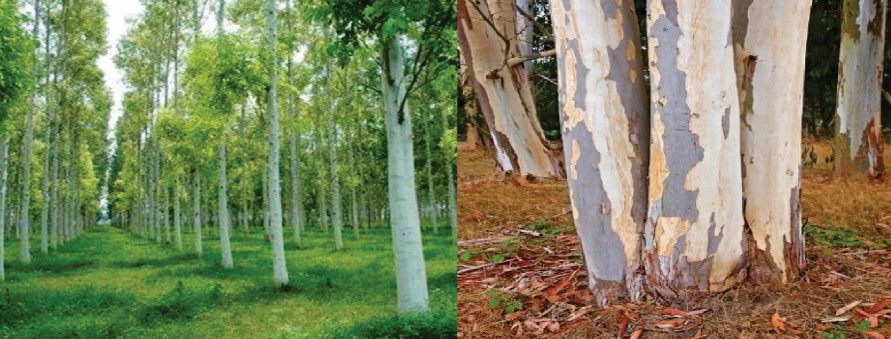
In South India, Andhra Pradesh and Telangana have taken the lead in commercial agroforestry, largely due to the promotion of clonal forestry by ITC Bhadrachalam Pvt. Ltd. This initiative has popularized the cultivation of species such as eucalyptus, casuarina, and subabul, meeting the raw material demands of the wood-based industry and advancing commercial agroforestry across the country. Additionally, Tamil Nadu Agricultural University has played a key role in popularizing the cultivation of Melia dubia (Malabar neem).
Present Status-Area Coverage
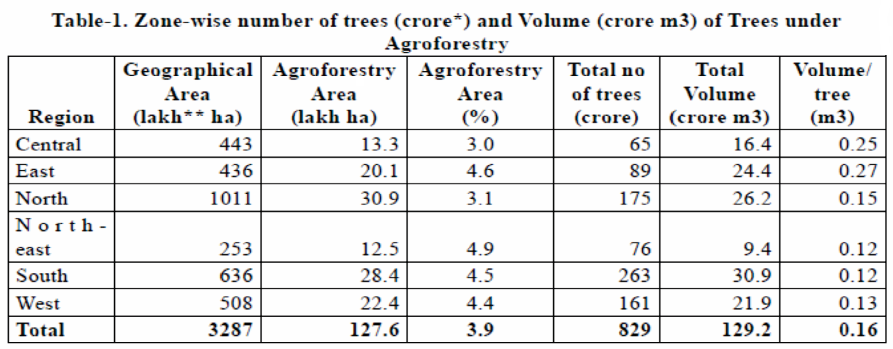
According to the ISFR- 2023, India’s agroforestry area was estimated at 128 lakh hectares, accounting for 3.9% of the country’s total geographical area. Over the past decade (2013–2023), the area under agroforestry has increased by 21 lakh hectares, marking a 20% rise.
As shown in Table 1, the highest percentage of agroforestry area is recorded in the northeastern region (4.9%), whereas the central and northern regions fall below the national average. The lower share in these regions can be attributed to intensive agricultural practices in the fertile northern plains and the high proportion of forested land in the central region.
Maharashtra, Rajasthan, and Uttar Pradesh are the top three states in terms of total area under agroforestry. Maharashtra’s rural landscape is largely supported by horticultural crops; Rajasthan, despite its arid conditions, features a high density of multipurpose tree species along with horticultural crops; and Uttar Pradesh is known for extensive cultivation of eucalyptus and poplar and horticultural crops.
Growing Stock
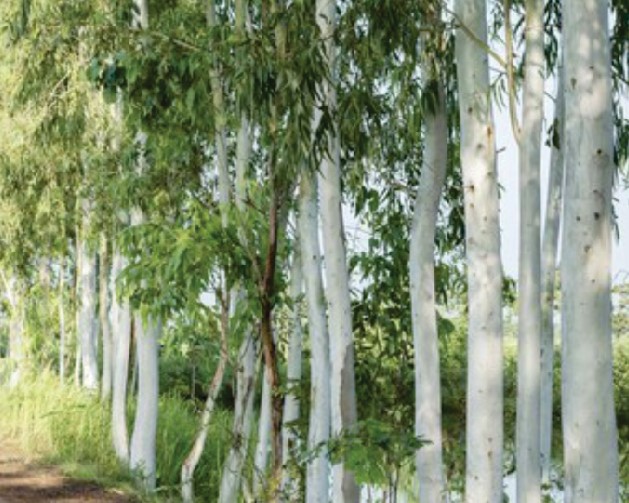
As per the ISFR- 2023, India has approximately 829 crore trees under agroforestry, with the total growing stock volume estimated at 129 crore cubic meters. Between 2013 and 2023, the growing stock under agroforestry increased by 29 crore m³, representing a 29% rise.
Regionally, the southern part of the country leads with 263 crore agroforestry trees, while the central region has the lowest count, with just 65 crore trees. Maharashtra tops the list of states with the highest number of agroforestry trees, followed by Karnataka, Uttar Pradesh, Rajasthan, Tamil Nadu, and Kerala.

According to ISFR- 2023, the top ten species by number of trees under agroforestry are:
- Mangifera indica (mango)
- Azadirachta indica (neem)
- Prosopis juliflora (mesquite)
- Areca catechu (areca palm)
- Eucalyptus spp. (safeda)
- Tectona grandis (teak)
- Cocos nucifera (coconut)
- Butea monosperma (dhak)
- Acacia nilotica (kikar)
- Ziziphus mauritiana (ber)
The increased planting of eucalyptus and teak indicates their rising importance as sources of industrial wood in India.
Notably, subabul and poplar rank twelfth and twenty-fourth, respectively, while casuarina and Malabar neem do not appear among the top 50 species in agroforestry by tree count.
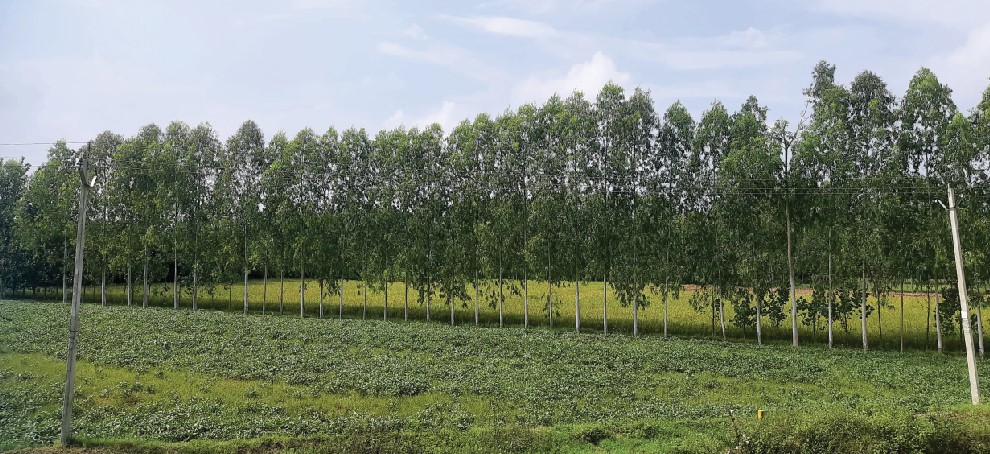
Traditional multipurpose species such as neem, dhak, and kikar remain naturally occurring or widely planted in rural landscapes due to their resilience and utility.
Additionally, four fruit-bearing species—mango, areca palm, coconut, and ber—are gaining popularity owing to their higher profitability. These species are actively promoted under India’s National Horticulture Mission and contribute to wood production once they become unproductive.
Wood Production
According to the ISFR- 2023, the potential annual production of industrial wood from Trees Outside Forests (TOF) is estimated at 915 lakh cubic meters. This represents an increase of approximately 225 lakh m³ (30%) over the industrial wood estimates reported in ISFR- 2017. Notably, this production meets about 85% of India’s total industrial wood demand.
Agroforestry accounts for around 42% of the total area under TOF, yet contributes approximately 77% of the tree volume, highlighting its significant role in wood production. This higher contribution is primarily due to the shorter harvesting cycles of commercial tree crops and bamboo clumps commonly grown in agroforestry systems, making them more productive and efficient compared to other TOF areas.
Recommendations
To further strengthen the agroforestry sector in India, the following recommendations are proposed:
- Improvement of Planting Stock for Commercial Tree Species
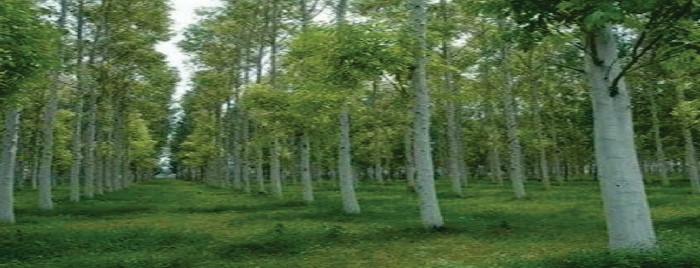
Continuous improvement of planting material for widely used commercial species such as eucalyptus, poplar, casuarina, subabul, Malabar neem, teak, auriculiformis, ailanthus, shisham, silver oak, and bakain is essential.
This includes the development of high-yielding, disease-resistant, and drought-tolerant varieties or clones. Enhancing the productivity of these species will help meet the raw material needs of wood-based industries and reduce the country’s dependence on wood imports
- Enhancement of Multipurpose Tree Species (MPTs)
The productivity of traditional multipurpose tree species such as neem, dhak, kikar, ronj, bhimal, desi papri, mahua, badam papri, jand, jamun, imli, and arjun should be improved. This can increase the yield of non-timber forest products (NTFPs), foster their commercial utilization, and enhance rural livelihoods. Promoting these species also supports the integration of ecological and economic benefits within agroforestry systems.
- Management of Invasive Species
The rapid spread of mesquite, which ranks third among agroforestry species in 2023, is a growing concern. While it serves as a source of free fuelwood and thrives in saline or alkaline soils, its unchecked expansion in unsuitable areas is detrimental. Targeted eradication from ecologically sensitive zones is necessary, along with its regulated use on degraded or problematic lands where it can provide benefits without harming native ecosystems.
Conclusion
The development of the agroforestry sector is vital to meeting the rising domestic demand for timber, non-timber forest products, and industrial raw materials.
A robust agroforestry strategy will enhance farmers’ incomes, create employment opportunities, and contribute to climate change mitigation, groundwater recharge, and the conservation of natural forests.
Furthermore, it can help conserve foreign exchange by reducing wood imports and boost government revenues through increased tax collection. Promoting agroforestry also plays a crucial role in ecological sustainability and long-term environmental conservation.
👇 Please Note 👇
Thank you for reading our article!
If you don’t received industries updates, News & our daily articles
please Whatsapp your Wapp No. or V Card on 8278298590, your number will be added in our broadcasting list.




 Hindi
Hindi 

Ply insight launched on March 2018 with a vision to make a platform to collaborate plywood MDF, Laminate, machinery manufactures with dealers in the Trade.
Categories
Useful Links
Follow Us