

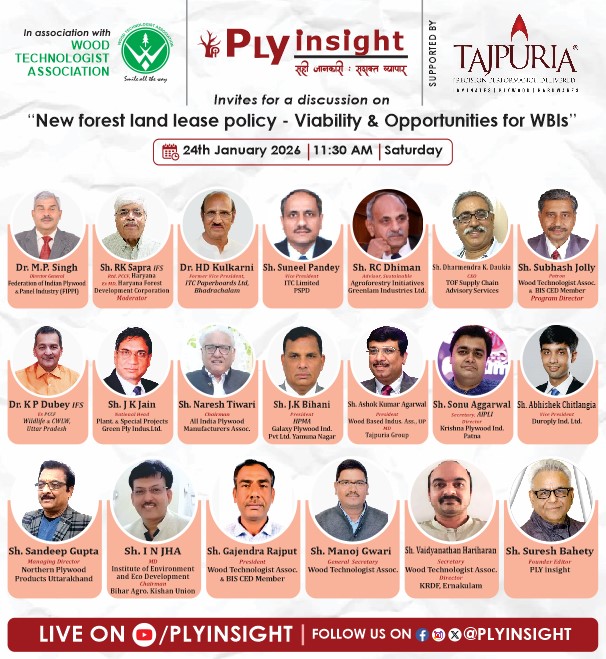
New Forest Land Lease Policy – Viability & Opportunities for WBIs
- February 13, 2026
- 0
Collaborative Forestry, Policy Reforms, and the Road Ahead for India’s Wood-Based Industries
The discussion captures a landmark moment in India’s forestry and wood-based industry policy landscape, marking the culmination of nearly three decades of debate, negotiation, and policy evolution.
Context and Objectives of the Policy Reform
The Central Government’s amended guidelines redefine and clarify what constitutes “forestry activity” under the Forest Conservation framework. The intent is not to lease forest land to industries but to enable collaborative plantations, wherein the forest land remains under the ownership and protection of the State Forest Department, while industries participate through investment, technical inputs, and assured offtake of produce.
The objectives of this policy are:
- To provide necessary raw materials to the industry.
- To reduce expenditure on imports.
- To increase green cover and improve the environment.
- To increase employment opportunities.
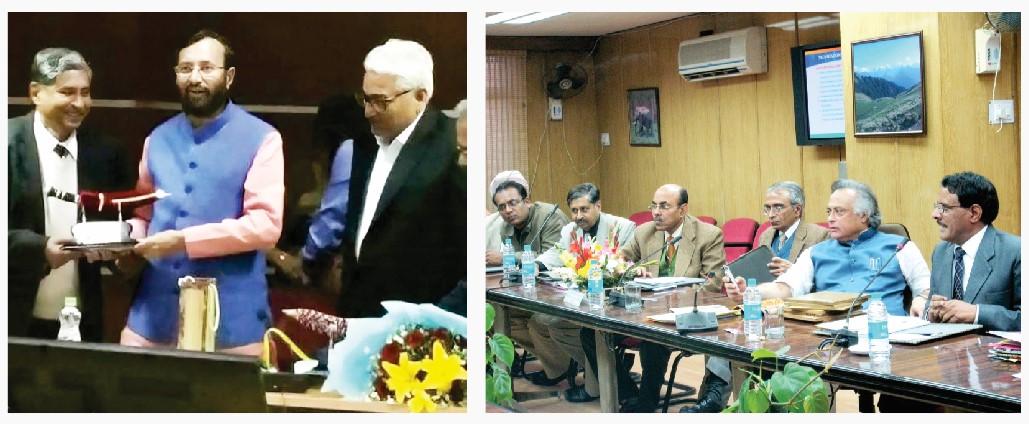
India leads in wood consumption in Asia. According to available data:
- Forest Cover: 678,333 square kilometers (20.64% of geographical area)
- Dense Forest: 51,285 square kilometers
- Moderately Dense Forest: 333,280 square kilometers
- Open Forest: 287,000 square kilometers
- Mangrove Forest Area: 4,461 square kilometers
- Non-Forest Area (excluding scrub): 2,570,000 square kilometers
India already leads Asia in wood consumption, yet forest productivity remains low. With forest cover at about 20.64% of the geographical area, and a significant proportion classified as open or degraded forest, the figures highlight the urgent need for productive interventions rather than passive conservation alone. (Subhash Jolly)
Three Decades of Policy Struggle
Speakers traced the long history of attempts to involve industry in plantation forestry. Since the mid-1980s, the Indian Paper Manufacturers Association and allied industries have sought access to degraded forest land, drawing inspiration from Western countries where unused or marginal lands were successfully allocated for industrial plantations.
However, multiple initiatives failed due to social opposition, environmental activism, policy ambiguities, and institutional hesitancy. Proposals by companies such as Harihar Polyfibers and ITC—ranging from joint ventures with state forest corporations to public-private partnerships—were eventually withdrawn or rejected.
The emergence of Net Present Value (NPV) and compensatory afforestation requirements further made such investments financially unviable, forcing industries to retreat from forest land and turn toward agroforestry on private farmland.
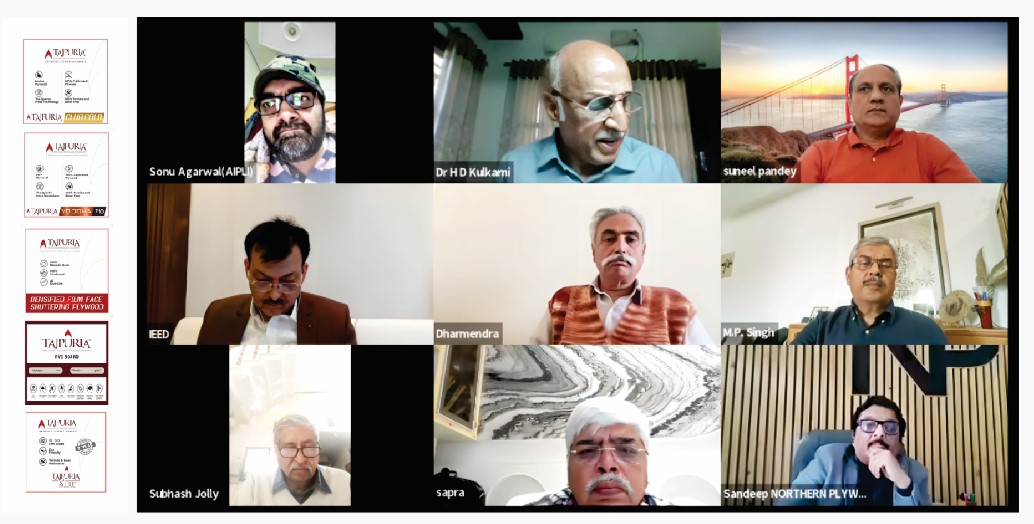
Shift Toward Agroforestry and Sustainability Models
From the early 2000s onward, industries increasingly adopted agroforestry models, sourcing wood directly from farmers. While this reduced policy risk and ensured some raw material supply, it also created new vulnerabilities.
Agroforestry competes with agricultural crops, pushing up land costs and timber prices. As a result, Indian industries today procure wood at significantly higher costs than their global competitors in Indonesia, Malaysia, or Brazil.
At the same time, sustainability frameworks such as Forest Stewardship Council certification and biodiversity-based plantation models emerged. Notable examples include ITC’s integrated plantation approach involving water conservation, biodiversity enhancement, and allied activities such as fishery and beekeeping. These models demonstrated that production forestry and sustainability are not mutually exclusive.
Significance of the New Order
The recent order issued by the Central Government is widely viewed as a breakthrough. It explicitly states that plantations raised on forest land under state supervision and incorporated into approved working plans are forestry activities—not non-forestry use.
Consequently, such plantations do not attract NPV or compensatory afforestation requirements. This single clarification removes the most significant financial and legal obstacle that had stalled collaborative forestry for decades.

Importantly, the order does not mandate land leasing. Instead, it enables collaborative plantation models, where:
- The land remains with the State Government.
- The industry’s investment is secured through legal agreements.
- All activities are carried out under approved working plans, ensuring continuity and ecological oversight.
Role of Working Plans and Ground-Level Implementation
A recurring theme in the discussion is the central role of Working Plans. While the National Working Plan Code-2023 is progressive and flexible, its implementation at the state and district levels remains the primary challenge.

Over the past two decades, many states have merged plantation-focused working circles into “Improvement Working Circles,” shifting the emphasis toward biodiversity and forest cover enhancement while sidelining production objectives.
The discussion highlighted that working plans are amendable and need not wait for their full 10-year cycle to lapse. If suitable provisions already exist regarding species and rotation, Detailed Project Reports (DPRs) can be approved relatively quickly.

Investment Viability and Rotation Cycles
Industry representatives stressed that plantation viability depends heavily on rotation length. Short rotations may suffice for pulpwood, but plywood, veneer, and furniture industries require long-rotation timber. Agroforestry cannot meet this demand adequately, especially for high-grade face veneer, which is currently imported in large quantities.
Legal Stability and Risk Perception
Concerns were raised about policy reversals, judicial interventions, and changes in government priorities. However, it was noted that long-term agreements in sectors such as mining continue despite political changes. The 2023 amendments have already been reviewed by the Supreme Court, lending legal credibility to the framework. While future challenges cannot be ruled out, structured agreements with state governments provide reasonable investment security.
Role of State Forest Development Corporations and Panchayat Land
The discussion differentiated between forest land and other land categories. Forest land plantations will follow the collaborative model under the Forest Department’s supervision. Panchayat and revenue lands, on the other hand, may follow lease-based agroforestry models involving local bodies, with profit-sharing arrangements and legal safeguards.
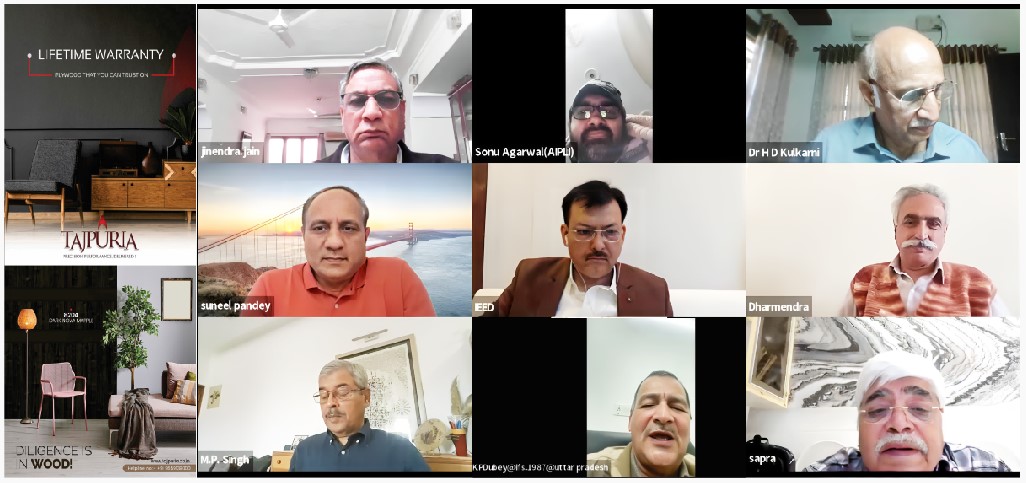
Role of Pilot Projects
Speakers repeatedly emphasized the importance of pilot projects. Large-scale implementation without tested models could invite criticism and resistance. Pilot plantations of 10 to 100 hectares, supported by detailed DPRs and stakeholder consultations, were seen as the most prudent starting point.
Carbon Credits, Green Credits, and Future Revenue Streams
Beyond timber production, the policy opens doors for carbon credits and green credits. Several large corporations outside the timber sector have expressed willingness to invest in plantations purely for environmental offsets. This diversification of revenue streams can enhance project viability and align forestry initiatives with India’s climate commitments.
Governance, Coordination, and the Way Forward
The discussion concluded with a clear consensus that success depends on coordinated action at three levels:
- Government of India – for overarching policy guidance, monitoring, and support.
- State Governments – for working plan revisions, land identification, and agreement execution.
- District and Field Level – for practical implementation through DFOs and forest divisions.
A small, focused national-level coordination group was proposed to guide implementation, address emerging challenges, and maintain consistency across states. Industry associations such as IPMA and FIPPI were urged to work collectively to avoid fragmented or conflicting approaches.

Conclusion
The policy reform represents a rare alignment of economic, environmental, and social objectives. After 30 years of uncertainty, the framework now exists to revive production forestry on forest land without compromising conservation principles. While resistance and challenges are inevitable, the opportunity is unprecedented.
With patience, transparency, pilot-based implementation, and sustained engagement between industry and government, collaborative forestry can transform degraded forest land into productive green assets, strengthen India’s wood-based industries, generate employment, and contribute meaningfully to climate resilience.
This moment, as many participants noted,
Is not the end of the journey
But the beginning of a long-overdue transformation.
👇 Please Note 👇
Thank you for reading our article!
If you don’t received industries updates, News & our daily articles
please Whatsapp your Wapp No. or V Card on 8278298590, your number will be added in our broadcasting list.



 Hindi
Hindi 

Ply insight launched on March 2018 with a vision to make a platform to collaborate plywood MDF, Laminate, machinery manufactures with dealers in the Trade.
Categories
Useful Links
Follow Us