

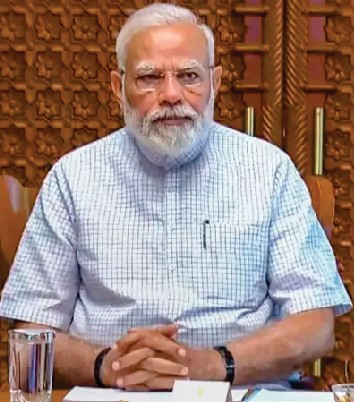
Reform, Perform, Transform PM Modi lays out a bold vision for India’s Global leadership
- June 11, 2025
- 0
There is a renewed trust across the globe towards India and its strength to lead the global agenda. In India, there is a revolution of reforms that is in motion. In a decade, we are in the top 5 economies globally. I assure you that in the next few years, you will see India as the 3rd largest economy. This is the speed that the young nation needs, and India in going with this speed.”
“Today, India is reforming with conviction and not out of compulsion. Big reforms can bring changes at scale, and we do understand their importance, which is why our government is committed to bringing is such reforms.
India was once a country where access to credit was a major challenge. Our government has transformed this landscape by banking the unbanked, securing the unsecured, and funding the unfunded, ensuring financial inclusion for all.
Pradhan Mantri Mudra Yojana (PMMY) has revolutionized financial inclusion by providing collateral-free loans to small and micro enterprises, enabling entrepreneurship and economic empowerment. This initiative has bridged the gap in credit access, particularly for small businesses, women entrepreneurs, artisans, and self-emloyed individuals, who previously struggled to secure financial support.
In the past decade, we have transformed fear of business into ease of business. Infrastructure has seen remarkable progress, with lower logistics costs and higher efficiency. We are streamlining regulations, and with Jan Vishwas 2.0, compliance requirements are being further simplified.
India is harnessing the opportunities of the 4th Industrial Revolution, aka Industry 4.0, aligning seamlessly with the global business landscape. Our government has opened multiple new sectors for private participation, fostering collaboration and progress. Industries such as space, renewable energy, and power distribution are withnessing increased private-sector involvement.

Over the past 10 years, 25 crore Indians have risen above the poverty line, joining the neo-middle class. The zero-income tax up to 12 lakh is a transformative step, serving as both a game changer and a major stimulus. The Viksit Bharat agenda is driven by trust.
India keeps moving in the direction of fulfilling Viksit Bharat through far-reaching reforms for improving governance, strengthening state capacity, and harnessing technology for sustainable growth. A key part of this change is the digitization of government services. The Unified Payments Interface (UPI) has become a pillar of India’s digital economy.
The PM Gatishakti National Master Plan, which was unveiled in October 2021, seeks to increase multimodal connectivity and lower the cost of logistics. Through data convergence from several ministries and states, the plan has enhanced probject implementation efficiency, resulting in accelerated completion and costs savings. The government is set to reduce the cost of logistics from the present 13% of GDP to 8%, in line with international standards.
Economically, India has risen from being the world’s tenth-largest economy in 2014 to the fifth largest by 2024, with a GDP of $3.7 trillion. Forecasts suggest that India is likely to become the third-largest economy, with a GDP of $5 trillion over the next three years. The trend is an outcome of the country’s strong microeconomic policies and reformative drives.
Collectively, these developments underscore India’s commitment to fosterning a resilient, inclusive, and technologically advanced economy, propelling the nation closer to realizing the vision of Viksit Bharat.
👇 Please Note 👇
Thank you for reading our article!
If you don’t received industries updates, News & our daily articles
please Whatsapp your Wapp No. or V Card on 8278298590, your number will be added in our broadcasting list.



 Hindi
Hindi 
Ply insight launched on March 2018 with a vision to make a platform to collaborate plywood MDF, Laminate, machinery manufactures with dealers in the Trade.
Categories
Useful Links
Follow Us