

This is a period of change, keep an eye on it, take a decision only when there is some clarity
- May 8, 2025
- 0
On one hand, the prices of wood are increasing. While BIS standards have become mandatory on the other side. That means the challenges have doubled.
Overall, we can say that this is a period of transformation. Such situations will remain for some time. Which is creating uncertainty in business. Therefore, before taking any important investment related decision, one should analyze the situation with patience. It will be better if a decision is taken only when the situation is somewhat clear.
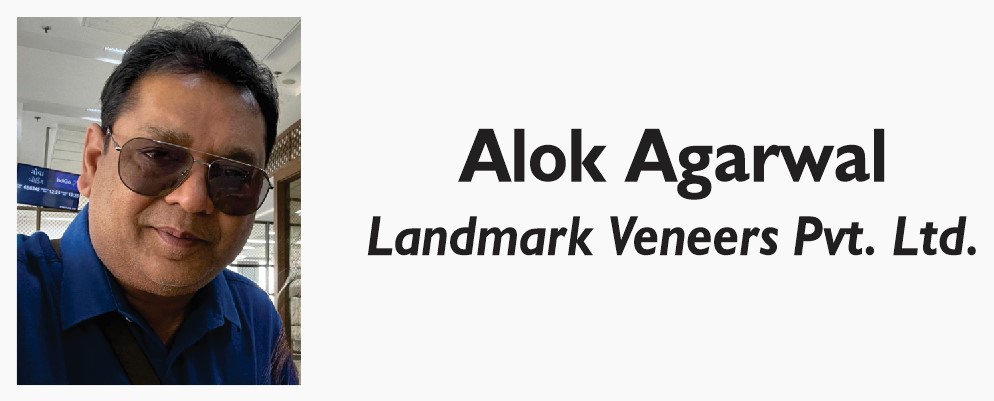
This is the opinion of Alok Agarwal, a veneer manufacturer in Gabon, Africa. Alok Agarwal has earlier been a plywood manufacturer in Gandhi Dham. Now he is working in Africa.
Working conditions in Gabon
When we invested in Gabon, the profit was good, but with time, the number of units is increasing here too. Therefore, the profit is not that much. Sometimes the situation also becomes stressful. Many units are closing here too.
Running a unit abroad is also not easy. That too under military rule. Firstly, the rules are strict here, secondly, they have to be followed in every circumstances. Therefore, a kind of mental pressure also remains.

Secondly, there is also an apprehension on longevity of policies of the local government.
We can say that we are facing more problems in gabon than India at the moment. Inspired by the availability of wood, industrialists had moved to countries like Africa. But this does not mean that all the problems are resolved. The difference is that now the problem is of a different kind.
Working conditions in Gandhidham
Similarly, industrialists from Yamunanagar and North are now setting up units in Gandhidham. The price of wood has increased a lot in North India. It is relatively cheaper to prepare goods in Gandhidham. The raw material wood or core imported here is relatively cheaper. But there is a different kind of problem here as well.
Firstly, the way of working here is different. There is lack of skilled workers in Gandhidham. Another problem in Gandhidham is that it is very hot. This also affects the productivity of the workers. Now the industrialists coming from Yamunanagar and outside may change the work environment a bit.
In Gandhidham most of the factories are somehow maintaining themselves, only 25 percent of the industries are in a position to earn profit. Here the board and door manufacturers are relatively more successful, but the success ratio in plywood is relatively less.
Neither could the producers in Gandhidham become a brand, nor could they remain in the lower category. The industrialists will have to pay attention to this as well.
Import of wood and core in Gandhidham
Now the core of pine and eucalyptus is used in abundance in Gandhidham. Some use only pine and some use only Eucalyptus. Earlier wood was imported from Brazil, South Africa, Uruguay, Argentina. Now for the last two-three months, core is coming from Tanzania. Due to this the situation seems to be improving a bit, but a doubt remains. It is unpredictable when that government will change their policy, due to which the import will stop again.
It was closed till six months back. Therefore, such apprehensions remain in future as well. We cannot depend on imports always, because we do not know when and which government policy may change.
Not the pine core but the pine wood is coming from New Zealand and Australia, which is peeled in Gandhidham. There is a good demand for it in North India. In fact, many North Indian industrialists have also installed their peeling machines here.
Challenges in import of core and wood
Whichever goods are imported in India, their billing is complete. Payment for such goods has to be made in advance. That’s why, payment has to be made in cash or there should be an LC.
Most of the manufacturers of North India either do not have or don’t want to work on LCS.
Plywood used to come from China on under billing, but raw material comes on full bill. Anyway, the international wood suppliers sell the goods on full bill only.
Because in China, there is also a discount on their export. That is why they do not work on under billing. Another reason is that it does not matter to Chinese exporters whatever the payment mode is.
Shifting your plant to another state
The industrialist who has been working in a particular place for years is already familiar with the in and out of that place. There will be new kinds of challenges in new place. Some will make the work easier while some will create difficulties. Therefore, any industrialist should avoid shifting his running unit to another place. Because shifting alone can cost one to two crore rupees.
The state government’s efforts to encourage industries have been successful in many places, in which many kinds of concessions are available. Due to which some additional income is seen in the day-to-day work. This is good for new industries. Because with such concessions, they get initial benefits. This can make work easier.
Situation after implementation of QCO
As far as BIS standards are concerned, this is an opportunity for Indian industrialists. Because right now plywood producers of Vietnam and China cannot meet Indian standards. The reason for this is that there are no dryers in Vietnam’s factories. These units will find it difficult to get a BIS license. The flow of goods coming from Vietnam will certainly break.
There are some gas-operated dryer’s factories in China. Therefore, there is no challenge from China right now. Most of the units in Nepal can meet Indian standards. Because most of them are Indian expatriates. Still the big challenge is that Indian plywood manufacturers are not coming forward to take BIS. This mindset should be changed.
👇 Please Note 👇
Thank you for reading our article!
If you don’t received industries updates, News & our daily articles
please Whatsapp your Wapp No. or V Card on 8278298592, your number will be added in our broadcasting list.



 Hindi
Hindi 

Ply insight launched on March 2018 with a vision to make a platform to collaborate plywood MDF, Laminate, machinery manufactures with dealers in the Trade.
Categories
Useful Links
Follow Us