

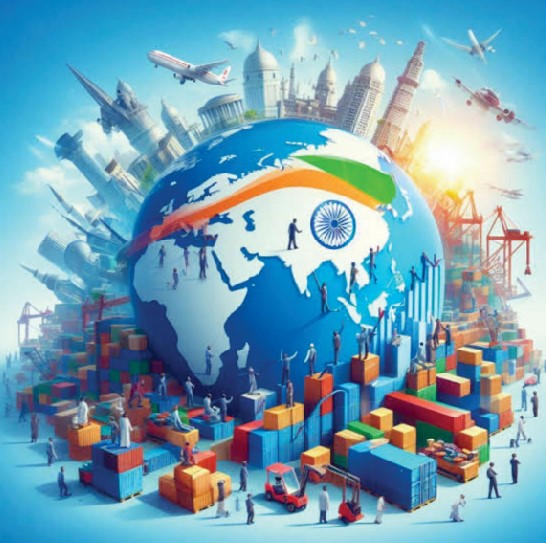
India’s domestic market-focused moves
- August 8, 2025
- 0
Economists never fail to point out that no economy has been able to sustain a growth rate of over 7 per cent without a strong export boom.
The focus of policy has shifted across the world and now policies are being formulated more on industries within the country. The era of free trade, the promise of shared benefits from a globalised world of unfettered movement of capital and technology, and the sanctity of rules may be a thing of the past. This is unfortunate but true. The geopolitical divide and the paradox of globalisation can be clearly seen in the last few years.
However, if exports cannot be the engine of growth, how will India’s Gross Domestic Product (GDP) grow at 8% per annum, which is necessary to achieve the goal of developed India by 2047.
The Economic Survey 2024-2025 answers this: India will have to depend more on domestic markets and less on exports. Only then will growth be accelerated in the coming years. But the big question is whether this will really achieve an 8% annual growth rate?
In the coming years, the trend towards inward or within the country will continue due to two reasons. The first reason is the slowdown in world trade. Tariffs have come down everywhere, but countries have created other barriers besides tariffs, which hinder trade.
Trump’s tariffs and counter-tariffs imposed by other countries can take the obstacles in the way of free trade to a whole new level. This will also be a strong reason to cut imports and make imported goods within the country.
The third major reason for India’s reliance on domestic production is that we have to reduce our dependence on China. The review says, “If many products are ordered from only one place, then India can be at risk in case of supply chain disruptions, price fluctuations and currency risks.”

The review includes strengthening the supply chain within the country and finding alternative sources of supply even if those sources are not economical. It says that competing in the export market by buying materials at the lowest price is not always the priority.
In today’s era, self-reliance and national security are the factors that decide where to get raw materials from. And this idea is not only India’s.
One mantra in the post-liberalisation era has been that protectionism or high tariffs hurt growth. But this time round, protectionism is not so bad. The era of industrial policy that promotes growth in selected sectors by selected industrial groups is back.
Like other countries, India’s economic policy has also been focusing on indigenous industries for the last few years. The government introduced the Production Linked Incentives (PLI) scheme in March 2020, which aims to increase indigenous production through higher tariffs and subsidies on imports.
The rules for the use of indigenous materials in India say that only indigenous components have to be used up to a certain limit in certain projects. Also, indigenous producers are given preference in government procurement.
Critics called these anti-reform steps, but today these seems to be visionary steps.
👇 Please Note 👇
Thank you for reading our article!
If you don’t received industries updates, News & our daily articles
please Whatsapp your Wapp No. or V Card on 8278298590, your number will be added in our broadcasting list.


 Hindi
Hindi 
Ply insight launched on March 2018 with a vision to make a platform to collaborate plywood MDF, Laminate, machinery manufactures with dealers in the Trade.
Categories
Useful Links
Follow Us