

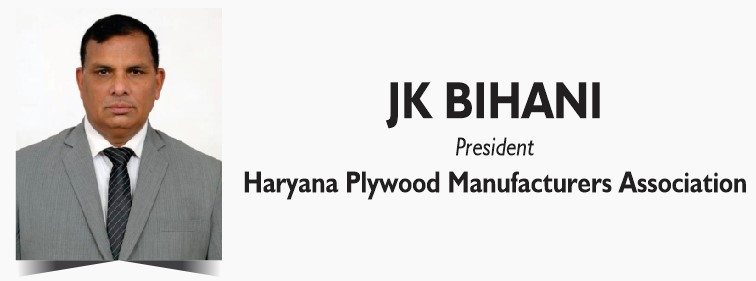
Retention can be avoided by marking shuttering ply as IS 303
- August 1, 2025
- 0
Retention has been made mandatory in shuttering plywood?
Actually, there is no need for retention in shuttering plywood. Because what is the life span of this ply? This ply is used for a very short duration, about four to six months. Ten to fifteen or twenty times. That too outdoors.
This kind of treatment should be done with the ply which is to be used for a long time, like marine ply. Now since marine ply is to be used for a long time, it must have retention treatment.
Currently, the other option left with the industry is that if shuttering ply is marked as IS 303 BWP or BWR Plywood, then this compulsion can be avoided. Because the compulsion of face has been abolished in IS 303. And you can also use film face without any objection.
So many categories of ply have been made in BIS, hasn’t this made things complex for the manufacturers?
There was no need to make so many categories. It would have been better if the categories were less and simpler. However, now the manufacturers will have to focus on the bonding strength of their ply.
Typically, if the bonding is good – even average, then everything will go hassle free. Because even average bonding will easily pass in the category of F 10 to F 30.
The requirement of F 50 or more is the maximum, which can be achieved by efficient and capable factories. Industries can mark lower categories for safe approach. That is, if your ply passes F40, then it can be marked as F 30. This can be considered as a safe compliance method and it can remove the apprehensions of the manufacturers.
Is everything fair in the testing process of IS 303?
No, not entirely. The requirement of three cycles of three hours at 60 degrees is too strict for MR ply. Testing should be limited to 40 degrees or room temperature for one to two hours for general purpose plywood. Or it should be made 50 degrees. Because in states like Rajasthan, where the heat is high, it will be able to bear the heat there.
After all, this plywood is for general use only. When the standards are strict on special products, then such manufacturers will also make the goods accordingly.
But now that this rule is applicable, it will have to be followed. But the next time whenever it is amended, we will definitely raise our concern in this regard.
The action of the NGT on resin kettle is very challenging?
With this action of the NGT, factories are being encouraged to outsource resin. Which can become a challenge for our business confidentiality and quality. We are requesting the state government to adopt a sympathetic attitude towards the industry and provide a industry friendly environment. Otherwise, the industry, struggling with the shortage of raw material, may go into the abyss. The only resins manufacturers may also face problems, if we have to struggle.
Agricultural urea is still being used in resin?
There is huge difference in the prices of agricultural and industrial grade urea. Therefore, some manufacturers still use agricultural urea. Such industries mixes agricultural urea and industrial urea. It makes their production cost goes down. Due to this, they sell their product cheaper.
A middle path should be generated for urea pricing. The government should also subsidize the industry and reduce the difference in the prices of both grades. Ultimately, this game of hide and seek should end. So that all the industrialists can focus on the development of their business with a peaceful mind.
Has any notice been given to close the resin plant?
No notice has been issued so far to close the resin plant in Haryana. In the NOC (no objection certificates) issued by the Pollution Control Board, resin plant is mentioned in the certificates of almost all the old units. For some reason, it is not mentioned in some certificates. However, when the certificates are renewed, only information about the machine and unit expansion is required.
According to the information received, information about the presence of resin plant in many industries was sought. Some factory owners denied having resin kettle, fearing possible penalties. According to me, this was not a wise choice. Because now it has come in the records of the board that they do not have a resin plant. Anyway, we can talk to the government about the resin plant. And we can present our grievances. Through which a middle path could be found. But by refusing directly, perhaps this option has been lost.
Do the government responding to industry’s concerns?
The government is serious about plywood industry. Especially since UP has announced several concessions by inviting plywood manufacturers of other states, the Haryana government is in regular touch with plywood manufacturers. We have held two meetings with the CM’s political advisor in June. In which we have apprised him of the problems faced by the plywood industry. The problem of electricity bills was raised. Moreover, we are not able to get the benefits of the center because of the unauthorized land status. The ground water authority is another hurdle. It has to be renewed every year. This kind of practical problem has been put before them. We are hopeful from the government’s attitude and hope that we will definitely get some relief.
The manufacturers have demanded from BIS that they want exemption in testing of flush door and black board?
There is a indentation test in flush door where a steel ball weighing half a kilo is dropped, which should not be more than 0.2 mm deep. It is very difficult to achieve this in the juvenile wood being used. We had also requested the BIS to increase this from 0.2 to 0.5 or at least to 0.4. By doing this, the industry will feel a little safe. Otherwise, the industry may start surrendering this license.

QCO date is getting close for micro plywood manufacturers?
Micro should be given an additional one year. The reason for this is that everyone has not taken the license yet.
The solution to this problem is that the product should be as per the set standards, how it is achieved, this should be left to the manufacturer.
Instead of mandatory laboratory they should be allowed to get its product tested from anywhere, as long as the product meet the standards. If this arrangement is made, then many problems will be solved. The BIS officer or expert should focus on the product itself. How the industry is achieving this quality, manufacturers should decide for itself.
Yes, then the manufacturer will have to pay special care that there should not be any product below F10 in his production premises.
What is your stance on the rejection?
Rejection is a big issue. Plywood cannot be recycled. The industry claims that it should be between two to ten percent. Which should be allowed to sale as rejected. In this regard, IWST Bangalore replied that this is a policy matter. DPIIT should be addressed to in this regard.
Voice should be raised on this immediately. When QCO is fully implemented in August, some solution to this problem can be found before that. For this, all associations will have to be active.
The department has taken strict steps in Kerala and sent a message that now there will be no relaxation in the time limit?
This is true, in Kerala, unlicensed particle board and plywood factories have been closed. Apart from Kerala, Bihar and West Bengal also have very few ISI licenses.
By sealing the factory, the department has tried to send a message that this can happen with others as well. This could be a warning signal and department’s way of showing strictness.
Although an argument can be given that goods without ISI cannot be sold in India, but there should be no problem in its manufacture. We can also manufacture goods for export. This can be a legal point. But how practical this point will prove in the ground, is a matter of time.
GST raids have been conducted on some plywood business houses?
No manufacturer wants to break the rules. But the problem arises when he is forced to break the rules. There can be only one solution to this problem, that is to reduce the tax. If the tax is reduced from 18 to 5, then this problem will be vanished automatically. The government should pay attention to this. If GST is reduced, then nobody will try to evade tax.
However, in the present circumstances, the industry should do business with restraint. On one hand, it is becoming difficult to sell the goods at reasonable rates, on the other hand, the unit will not get any chance to recover from the burden of such a lump sum heavy penalty.
The entire industry is affected by the one or two percent wrong doers industrialists who behave in such an unruly manner.
👇 Please Note 👇
Thank you for reading our article!
If you don’t received industries updates, News & our daily articles
please Whatsapp your Wapp No. or V Card on 8278298590, your number will be added in our broadcasting list.



 Hindi
Hindi 

Ply insight launched on March 2018 with a vision to make a platform to collaborate plywood MDF, Laminate, machinery manufactures with dealers in the Trade.
Categories
Useful Links
Follow Us