

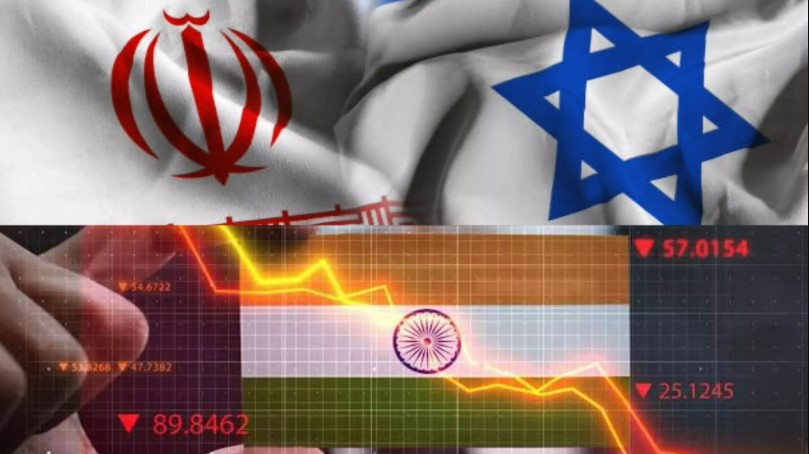
The Iran War Will Shape the Global Economy
- March 19, 2026
- 0
Everyone is talking about the war that has erupted in Iran: how long will it last? And how will it end? We do not have definite answers to either.
U.S. President Donald Trump has not achieved the quick victory he had hoped for. Even after the deaths of its Supreme Leader and around 40 senior leaders, Iran has not backed down. There has been no uprising among the Iranian people, and the leadership is not in the mood to surrender unconditionally to Trump.
It is difficult to predict how long this war will continue because the objectives of the United States are not clearly defined. President Trump and his associates have, at different times, announced varying goals.
Israel intends to continue its bombardment until Iran’s military and industrial infrastructure is destroyed. Iran, on the other hand, aims to demonstrate that any attack on it will come at a heavy cost to Israel, the United States, and their allies.
Brent crude prices were below $85 per barrel until March 6. There is a significant difference between oil prices at $80 and $100 per barrel. While $80 may be an inconvenience, $100 represents a serious disruption to the global economy.
Nearly 20% of the world’s oil and liquefied natural gas (LNG) passes through the Strait of Hormuz. Prices surged sharply from $80 to $100 per barrel when Iran announced that it would attack any ship passing through the strait. This threat has proven highly effective. And the average number of ships passing through the Strait of Hormuz daily has dropped from 153 to just 13. This represents a decline of more than 90% in maritime traffic.

Storage capacity is already at its peak, prompting Saudi Arabia and other oil producers to cut production. Some oil is transported via land pipelines, but these too are under threat from Iranian missiles. Oil refineries have also come under attack.
How the war ends is just as important as when it ends.
Based on current indications, the war is unlikely to conclude on U.S. terms. The Strait of Hormuz is unlikely to reopen quickly, and restoring insurance for ships passing through it will take time.
Restarting normal production in closed refineries will also be a gradual process.
If the Iranian government remains in power, Gulf countries that have been trying to diversify their economies away from oil into tourism and finance will also be affected.
In short, the end of the conflict will not mean a quick return to normalcy; in some cases, normal conditions may never fully return.
Under any scenario, the damage to the global economy will be significant.
👇 Please Note 👇
Thank you for reading our article!
If you don’t received industries updates, News & our daily articles
please Whatsapp your Wapp No. or V Card on 8278298590, your number will be added in our broadcasting list.




 Hindi
Hindi 

Ply insight launched on March 2018 with a vision to make a platform to collaborate plywood MDF, Laminate, machinery manufactures with dealers in the Trade.
Categories
Useful Links
Follow Us