

Viechi HMR TM Wet Veneer Adhesive Technique
- March 14, 2026
- 0
In today’s modern times, the plywood manufacturing industry is flourishing in India. Although our industry has adopted several modern technologies over the years, setting new benchmarks in plywood quality, process automation, and energy conservation, we still realize that the cost of producing our plywood is significantly higher than in other countries.
This is largely due to raw material wastage, high energy consumption during production, a high labor force, and final product rejections, which prevent the industry from becoming profitable.
While other countries produce high-quality products at affordable prices, our country’s production costs significantly, adversely affecting the industry’s economics.
Over the past two years, our association’s team analyzed process technologies used abroad and discovered a key point of overhead control: the resin manufacturing technology. Their resin, which is formulated with limited formaldehyde emissions, allows manufacturers to produce high-quality products using wet cores. Today, we will focus on this topic.
Plywood manufacturing in our country involves the following steps:
- Receiving an order from a customer
- Production planning
- Arranging raw materials
- Drying the veneer
- Plywood assembly
- Hot pressing the product
- Finishing the product
- Product testing
- Dispatch
This is a common plywood manufacturing process in our country. However, in the initial stages of production, we face a major challenge (especially during the monsoon and winter months) in drying the veneer for proper production. Mostindustries produce products with veneer moisture content of 6-8%. Although the industry is well aware of the benefits of using high-moisture veneer in the plywood manufacturing process, due to the lack of proper technology in the country, plywood is still manufactured using this process.
During our research, we have observed some significant advantages in manufacturing plywood with high-moisture veneer. Some of these are as follows:
- We have observed that veneer wastage in the plywood manufacturing process is at least 15%, which is due to product handling, drying, shrinkage, and assembly. Compared to the maximum wastage for high-moisture veneer, the wastage is only 5%, which can be reduced to approximately 2%.
- High-moisture core veneer offers manufacturers the opportunity for continuous production.
- Plywood made with high-moisture veneer produces defect-free plywood, resulting in a maximum rejection rate of 1-2% in the final process, compared to 5-10% in conventional processes.
- Manufacturing plywood with high-moisture veneer requires less human resources compared to conventional manufacturing processes, eliminating the need for annual salary costs and labor costs.
- Plywood production is more controlled and regulated.
- Reduced formaldehyde emissions result in a clean and gas-free environment, maintaining a consistent and pleasant atmosphere within the factory and complying with our environmental regulations.
- Lower energy and power consumption make the process more cost-effective and enhance our contribution to the national interest.
- Plywood made in this way is in high demand worldwide due to its quality and regulatory compliance, which increases its export potential.
Overall, the use of high-moisture veneers and resins with low formaldehyde emissions not only enables our manufacturing industry to achieve economic strength but also contributes to the nation’s welfare.
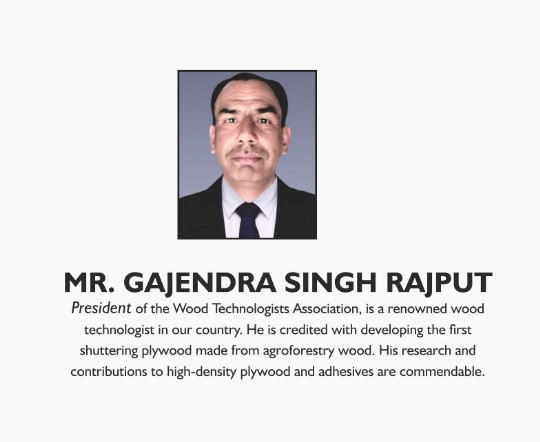
This technology is now fully available with the Wood Technologists Association. For more information, you can contact the Association’s President, Mr. Gajendra Rajput (+91 92159 28163) or General Secretary, Mr. Manoj Gwadi (+91 98975 44467).



 Hindi
Hindi 
Ply insight launched on March 2018 with a vision to make a platform to collaborate plywood MDF, Laminate, machinery manufactures with dealers in the Trade.
Categories
Useful Links
Follow Us