

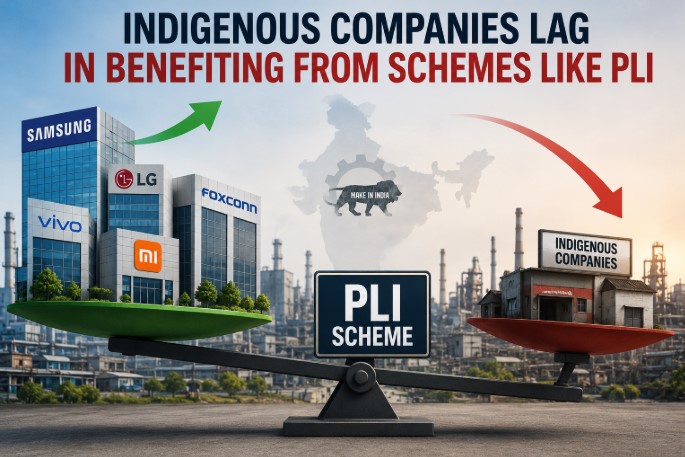
Indigenous Companies Lag in Benefiting from Schemes Like PLI
- August 12, 2026
- 0
The current government has transformed India into the world’s second-largest factory alongside being one of the biggest consumer markets. Initiatives such as Make in India and Production-Linked Incentive (PLI) schemes have played a major role in advancing the goal of self-reliance (swadeshi). However, foreign brands are reaping most of these benefits, while Indian companies are falling behind.
Due to strong policy efforts, India has emerged as the world’s largest market for consumer durables, electronic gadgets, and smart home appliances—not only as a consumer but also as a supplier.
Domestic mobile production, which was only ₹18,000 crore in 2014–15, has surged 28 times to ₹5.45 lakh crore by 2024–25. The PLI scheme has been the biggest driver of this growth.
Yet data shows that foreign brands have been the primary beneficiaries of this scheme. In the consumer durables and electronics sectors, brands from Taiwan, South Korea, and China are leveraging government policies the most. As a result, Indian manufacturers struggle to compete within their own market. Indigenous companies are unable to fully capitalize on such schemes.

Much of this progress is happening under intellectual property and brand ownership that India does not control. This raises concerns over long-term security because multinational companies can shift their manufacturing capacities to other countries whenever better cost advantages emerge.
The only way to truly position India as a global manufacturing hub is by strengthening Indian brands—so they can not only dominate the domestic market but also compete internationally.
Indian companies associated with the PLI scheme emphasize that they are not demanding exclusion of foreign brands. Instead, they seek priority, a level playing field, and fair evaluation of domestic value addition.
👇 Please Note 👇
Thank you for reading our article!
If you don’t received industries updates, News & our daily articles
please Whatsapp your Wapp No. or V Card on 8278298590, your number will be added in our broadcasting list.
Join our WhatsApp Channel “Ply & Panel Ind. News”


 Hindi
Hindi 
Ply insight launched on March 2018 with a vision to make a platform to collaborate plywood MDF, Laminate, machinery manufactures with dealers in the Trade.
Categories
Useful Links
Follow Us