


Deciding Factors for growth of height and girth in Eucalyptus
- April 7, 2025
- 0
An interesting discussion about the stagnation in young clonal Eucalyptus plantation took place in Agroforestry (Whatsapp) Group on the query raised by Jagdish Chander IFS Rtd. The excerpts have been given below.
Jagdish Chander IFS Rtd
I am reaching out with a question regarding a farmer who has planted clonal Eucalyptus trees. The trees are growing well in terms of height. However, the development of the girth is not satisfactory. While the poles are achieving good height, the stem thickness remains suboptimal.The farmer is keen on finding a solution to enhance the girth of trees without compromising their height. Kindly suggest possible techniques—such as pruning, nutritional management, or other management strategies—that might help in addressing this issue?
Ashish Misra, Greenlam Industries
Most common reason for tall yet lanky growth in Eucalyptus is attributed to more than optimal planting density. If spacing is closer than ideally suited for the site, such trees will not attain adequate girth.Thinning could be an option albeit site factors need to be studied before arriving at thinning regime and design.
Jagdish Chander IFS Rtd
Spacing is 10’x10′
Bala Prashad IFS Rtd
How old is the plantation? If it is not a young plantation, first harvesting the alternate rows may help in its girth development. But it would be better if an expert visit the site and provid advice.
 R C Dhiman Rtd, Wimco Industries
Tree height is mainly a function of site quality with some contribution of genetics and management. Remember, the top height determines the site quality. Better site quality produces taller trees. Initially, the height of trees is influenced by spacing of plantations. At latter stages of growth, height cannot be gained even by reduction of density of plantation.Pruning restricts the photosynthetic surface and checks the girth more than height.
V P TiwariRtd, FRI
Tree height is affected by many factors like genetics of species, climatic conditions viz. temperature and precipitation site quality, availability of sunlight, length of growing season, water availability, soil nutrients, competition with other trees, and altitude. Water availability and sunlight often being the most critical determinants of maximum height. Top height is not affected by the spacing and that is the reason it determines the site quality.
R K Sapra IFS Rtd
As I understood from the above discussion, the three-year-old eucalyptus plantation at spacing of 10’x10′ has gained excellent height. As far as my experience is concerned, it is not close spacing for the growth of three years old plantation. The clonal plants initially gain height then they gain girth. As the height of plants is higher, the gain in girth will be small.
The plants may be measured every six monthsin a year and the mean annual increment (mai) may be estimated which may provide a fair idea about their stagnation.
I am of the firm opinion that this plantation has not stagnated at present. We faced such situation in 6-7 years old clonal plantation at spacing of 10’x10’at Seonthi which I visited with Piarey Lal Vice President ITC Bhadrachalam and that the allegation of stagnation was found false.
 Dr HD Kulkarni Rtd, ITC Bhadrachalam
My experience on height vs girth of clonal eucalyptus.
- clone 3/7/413 etc. first grow in height and then put up girth (tall clones). Reverse is the case with clone 27/52, etc. which put up girth first and then height as they are dwarf clones. This is genetics as stated by Dr. V PTiwari.
- Spacing trial 1mx1m to 4mx4m put up in Bhadrachalam on the advice of Shri A N Chaturvedi (consultant to ITC) revealed that closer spacing favours height growth while wider spacing favours girth. As this growth is from coppice, the behaviour of clones and seedling was quite different and therefore we came to a conclusion to make clone wise volume tables. So Daukia ji, Dhiman ji, Ashish ji and Handa ji are correct- The spacing of plantation influencesits height.
- This dilemma we faced when the first plantation raised by APFDC complained in 1994 that the clonal plantations are stagnating. Trees have put up the height but not the girth. We replied that farmers’ plantations are exceedingly doing well (inter cropping practiced).
- What makes the difference is the timely application of Package of Practices (PoP). I feel that ploughing will make huge difference. If inthe initial 2 years, ploughing is done (at least twice), the problem of attaining girth can be overcome.
- On our advice, APFDC ploughed clonal plantation in the 3rd and 4th year during rains, which made a huge difference, and the trees had put up good girth. For this effort, I compliment A. K.Das CMD of APFDC who took this initiative and transformed clonal plantations.
- Similar problem was brought to our notice by JKPM Raigad and we advised them to plough and follow the PoP.
- Another lesson we learnt from Haryana (as brought out by Sapra ji) that if the site is not prepared well prior to planting, it will affect growth. Trees may attain more height but lesser girth.
 R K Sapra IFS Rtd
It was a forest site and slightly alkaline in few patches and ploughing is generally not done in forest plantations.
Dr HD Kulkarni, Rtd ITC Bhadrachalam
In Brazil, for clonal eucalyptus plantation, calcium is applied as fertilizer, as soils are deficient in calcium (Ca). In India, we advise application of NPK (Urea /DAP) in split dosages (2 application) in the PoP given to farmers. In Brazil by providing irrigation, the yield increases by 45 per cent. Application of fertilizers and irrigation provided good diameter growth and increased productivity.
Dr Ashok Kumar, FRI
Yes. However, I wish doses of Phosphorus and Potash would help more than nitrogen-based fertilization. Let’s also remember that both height and girth are nonetheless quantitative traits primarily and therefore applications of various fertilization would be of minimum assistance. This may therefore be looked upon as a genetic trial, and field testing is essential before proposed for commercial cultivation.

Though we often give examples of Brazil, never detail about existing methods of scientific field evaluation. Regretfully, it doesn’t exist in India and majority of propagation companies are making fool for financial benefits.
R K Sapra IFS Rtd
Kulkarni sahib is the real hero in this field.When a farmer in Pasiyala village of Ambala in Haryana was in distress, he guided him through his email. Second help came from Sunil Pandey, ITC Bhadrachalam who sent his representative from Chandigarh to inspect the plantation and guide the distressed farmer. With their help, we could save his treecropsworth Rs 10 lakh. I read his paper about clones in alkaline soils. When late AN Chaturvedi visited Pinjore (Haryana) long back, I referred to the clones of alkaline soils, but he totally refuted this claim.
These clones were later tested at Raina Farm, Kurukshetra and farmer shortlisted clone no 413 for commercial plantation. Such great work Mr Kulkarni has done.

Dr HD Kulkarni Rtd, ITC Bhadrachalam
Be it Brazil, Australia or India, the research experience available is to utilize and refine the PoPto help the farmers to get higher returns. Moreover, in ITC lot of experimentation is done with regard to clones fertilization and irrigation with multiple sites. The data is provided in publications (refer ENVIS) which become the basis for PoP recommendations. Studies were conducted in collaboration with CRIDA. The entire exercise is to increase the profitability of plantations to get the wood supply on sustainable basis to the mill and not to earn profit by selling the saplings.
The paper attached by Jagdish Chander was on Pinus radiata explains the role of N and P in diameter growth. Hence, I shared the experience on Eucalyptus in understanding and resolving the issue of diameter vs height growth.
Suneel Pandey,ITC Bhadrachalam
Now all POP advisories by ITC for eucalyptus/subabul/ casuarina clonal plantations are provided after soil testing and issuing of soil health cards to farmers. But only 50% of farmers follow advisories as they have a past decade of bias that more fertilizer means more wood production.
Now, we have started taking non-following farmers to star farmers who follow advised practices and have more productive plantations at lower cost of fertigation to see and discuss with them. It would take time, but certainly their perception would change. They are not illiterate, but they are just following what has given them benefit in the past.
The concept of fertigation basis soil testing and soil nutrient deficiency is a new concept (not prevalent even in green revolution states) and there is apprehension among them that it may not work. So, seeing is believing and concept of star farmers was mooted for this purpose.
Ajay Thakur, FRI
Excellent insight on height growth of eucalyptus clone has been suggested by learned people. Jagdish Chandra raised a genuine problem faced by a grower in Haryana. Preference of apical dominance is evident in some clones as mentioned by Kulkarni Sir. In general, eucalyptus has a preference of height growth in early 3 years, diameter growth increase afterwards.
My experience with farmersof Haryana: They prefer Urea and DAP followed by Urea. This provides more N than other nutrients and result is more height growth, instead of diameter growth. I usually suggest a different combination which has supplements of Ca and S, along with N and P. In initial doses, the ratio for NPK is kept 1.5:2:1;preferred fertilizer is SSP and 20:20:0:13(S); Supplement in the rainy season is soluble 20:20:0:13(S); Sulphur is good to regulate pH.Also, the prescription varies due to soil conditions.
R C Dhiman Rtd, Wimco Industries
Poplar was traditionally planted with 400 to 500 plants per ha. Now the number has goneto 600-700 plants per ha mainly due to farmers’ own innovations for adjusting spacing with low production cycles of 3 to 4 years compared 7 to 8 years earlier.
Same is the case with fertilization. Though some farmers have grown in for 2 to 3 generations now and simply apply a multiplication factor of 1.25 for fertilizers applied to crops, many others apply higher doses suo-moto.Heavily fertilized closed spaced eucalyptus also gets increased lodging and bending at least in North India.
R K Sapra IFS Rtd
Progressive farmers also work like scientist and they learn from their experience. I have learnt a lot from them. The book tells theory and they demonstrate through their experience. Many things are still not written in the book, but they describe them confidently which were found true.
V P Tewari Rtd, FRI
Any study related to ecological impact of application of heavy doses of fertilizers in plantations on the soils in the long run?Perhaps long-term use of chemical fertilizers may harden the soil, reduce soil fertility, pollute water and soil, lessen important nutrients of soil and minerals, thereby bringing hazards to the environment. Imbalanced use of chemical fertilizers can alter soil pH, and increase pests attack, acidification, and soil crust, which results in a decrease in soil organic carbon and useful organisms, stunting plant growth and yield.
 R C DhimanRtd, Wimco Industries
Our water bodies are already high in ammonia and nitrate contents. This is partly due to sewerage water being directly released and partly due to its seepagein water due to heavy fertilization.
Ajay Nioding Orient Paper Mill
Very well written Dr Kulkarni. Timely application of PoP makes such a huge difference. In the catchment area of Orient Paper Mills, there are many such cases.
But one specific case worth mentioning in Village Jodhpur of Shahdol district: This farmer Satyabhama Singh got 60 MT per acre in 5-year-old Eucalyptus plantation (clone no 413) after following PoP as given and intermittent irrigation as compared to 5 to 10 MT per acre in from majority of farmers who have not followed the same in areas just besides this plot. Inspite of repeated follow up by our team, only 25 to 30% of farmers in this area follow the PoP. Mostly farmers are marginal.
Jagdish Chander IFS Rtd
The farmer says that while the plants are growing at a comparable rate to others, he is seeking more substantial results that align with the effort and resources invested.
Dr HD Kulkarni Rtd,ITC Bhadrachalam
Excellent discussions on PoP. I draw attention of group members to the book NewGen Eucalyptus which covers the best practices guidelines in respect of clonal Eucalyptus esp. with reference to fertigation and irrigation and PoP followed world over and in India.
I am happy that Dr. Ajay Thakur (on fertigation) and Ajay Neoding (on PoP follow-up) have added more value to the discussions. Suneel Pandey has brought to the notice the latest information onstar farmers and extensions in respect to PoP. With this information, I am sure that Jagdish Chander got the answer to his query.
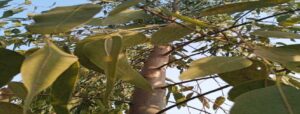
 The photographs of plantation tell the following:
- Trees are still in juvenile growth phase and growing in height.
- Self- pruning has not started. The girth growth starts once self pruning starts.
- Do not advise the concerned farmer to prune or thinning as it has no or less effect.
- In the first year, the girth will be around 14 to 18 cm; in the second year,the girth will be around 20 to 24 cm; inthe third year, the girth will be 30 to 34 cm and in the 4th year, it will be 40 to 45 cm in rain fed conditions.
I think the plantation is following the same rhythm of growth naturally. Let the farmer have patience and accept the rhythm of growth (in respect of girth and height).
Why obliterate the natural rhythm of growth? Excess fertigation and irrigation may result in little growth but will bring in a lot of adverse effects like lodging, spoiling soil conditions etc.
R K Sapra IFS Rtd
My earlier observation that the clonal plants are not stagnating has been found correct.
- All Photographs: Courtesy: Jagdish Chander, IFS Retd.
👇 Please Note 👇
Thank you for reading our article!
If you don’t received industries updates, News & our daily articles
please Whatsapp your Wapp No. or V Card on 8278298592, your number will be added in our broadcasting list.



 Hindi
Hindi 
Ply insight launched on March 2018 with a vision to make a platform to collaborate plywood MDF, Laminate, machinery manufactures with dealers in the Trade.
Categories
Useful Links
Follow Us