

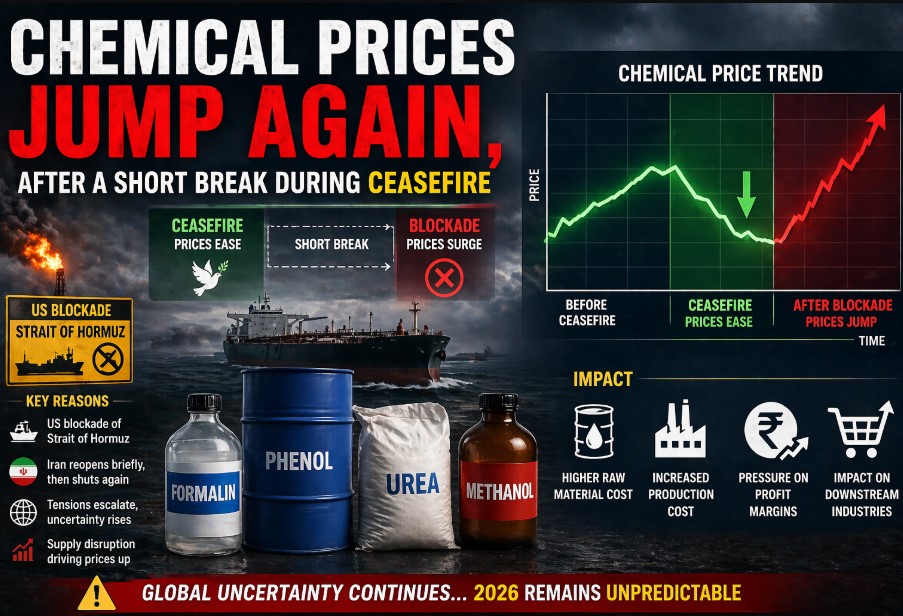
Chemical Prices Jump again, after a short break during ceasefire
- April 23, 2026
- 0
Following the unexpected decision by the United States to blockade the Strait of Hormuz, the future (2026) now appears uncertain.
In response to the U.S. move, Iran briefly reopened the Strait of Hormuz and then shut it again. As a result, political and economic conditions have worsened significantly compared to the initial phase of the ceasefire two weeks ago.
If, as reported, the powerful Islamic Revolutionary Guard Corps (IRGC) is actively sidelining political leaders, finding common ground may become difficult.
The U.S. blockade will undoubtedly restrict Iran’s export revenues as well as essential imports such as food, grains, and medicines, thereby increasing the suffering of its people. In fact, decades of increasing sanctions have already made the Iranian population accustomed to hardships. In such a situation, enduring another blockade may not be entirely unfamiliar to them.

The International Monetary Fund has already reduced its global growth forecast for 2026 from 3.3% to 3.1%. India and Southeast Asia, among the most dynamic regions in terms of economic growth, are bearing the brunt of the blockade. More than 80% of crude oil and other fossil fuels passing through the Strait of Hormuz from Gulf countries is destined for Asia.
The fact that around 90% of Iran’s oil exports go to China increases the risk of further deterioration in China–U.S. relations, the consequences of which could be unpredictable. Overall, the ceasefire and blockade have not altered ground realities which suggests that the year 2026 does not appear to be emerging from uncertainties.
The easing that had begun to appear in chemical prices after the ceasefire has reversed, and following news of the blockade, prices have surged again to their higher levels.
👇 Please Note 👇
Thank you for reading our article!
If you don’t received industries updates, News & our daily articles
please Whatsapp your Wapp No. or V Card on 8278298590, your number will be added in our broadcasting list.




 Hindi
Hindi 
Ply insight launched on March 2018 with a vision to make a platform to collaborate plywood MDF, Laminate, machinery manufactures with dealers in the Trade.
Categories
Useful Links
Follow Us