

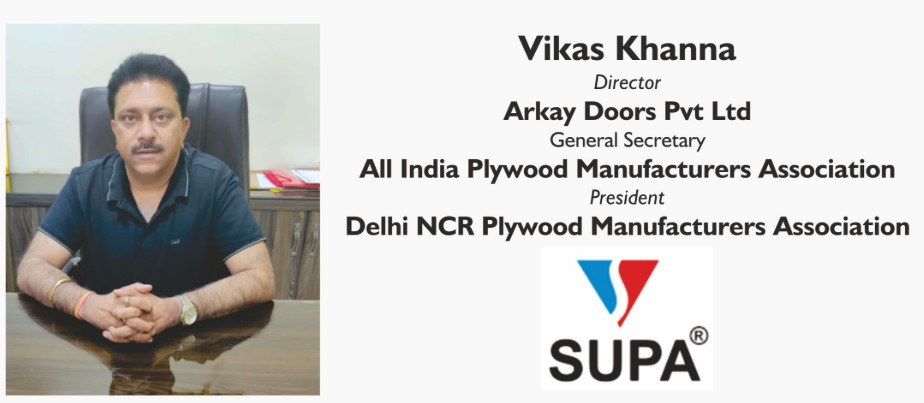
Adverse Circumstances Emerging from Challenges in the Plywood Industry
- October 10, 2025
- 0
How do you view the current state of the plywood industry and what are your expectations for the future?
After implementation of QCO, there was hope that conditions would improve. But so far, that doesn’t seem to be happening. Looking at the current situation, I feel such challenges will continue in the near future as well. The biggest problem is the availability of raw material. The fluctuations in demand and supply of timber make it difficult for industrialists to figure out how to balance things. If the mandi price of wood drops by even 50–100 rupees, farmers immediately stop cutting trees. The very next day, the prices rise again.
How do you see these challenges?
This is a difficult time. It has become very tough to continue the plywood industry. For the growth of any industry, such uncertainty in raw material availability creates big obstacles. Entire planning gets disrupted. Targets remain unmet, or if they are achieved, production costs go up significantly.
After the QCO, the import of plywood either stopped or reduced drastically. Very insignificant quantity is now coming to India from Nepal. Earlier, the argument was that cheap imported material was creating problems. Now imports are almost stopped. The market demand for plywood has also increased. So, we can’t say that the market is not responding.
Importing raw material can be a solution to this problem?
Yes,. Factory owners are somehow managing with imported pine and eucalyptus to some extent. But imports don’t have a fixed parameter either — the dollar value may rise or fall at any time. This situation is quite troubling. Industrialists are constantly stuck in this struggle — sometimes raw material shortage, sometimes delayed shipments — but the industry cannot stop. The ultimate question remains same: how to arrange raw material?

On top of this, weather is impacting a lot. Like this year, heavy rains completely disturbed the system. The returns are lower compared to the amount invested in plants, which leads to frustration.
What changes are visible in the industry after the Quality Control Order (QCO)?
See, QCO has been implemented, but the authorities neither put any pressure on the industry nor on the traders. If they put pressure on traders, it would actually be very beneficial for the industry. But that isn’t reflecting on the grounds. The reason is they don’t have enough manpower to handle. BIS act only if someone submits a written complaint. But why would anyone do that? Actually, this responsibility lies with BIS — they should be active on finding where fake plywood products are being sold and take action on their own, which they are not doing.
What’s happening instead is that they randomly take samples existing licensees. If sample report comes out negative, they shut down production. Whereas the real action should be taken against those selling counterfeit products.
People are setting up peeling units in Gandhidham to get core Instead of carrying imported timber
Yes, many people have set up peeling units in Gandhidham. Whoever wants to run an industry has no choice but to arrange raw material somehow, otherwise overhead costs will finish them. It has become a case of “survival of the fittest.” That’s why people are trying different ways to secure raw material.
This is an attempt to meet the shortage of raw material. In a way, it gives some positive hope for the industry.
👇 Please Note 👇
Thank you for reading our article!
If you don’t received industries updates, News & our daily articles
please Whatsapp your Wapp No. or V Card on 8278298590, your number will be added in our broadcasting list.



 Hindi
Hindi 
Ply insight launched on March 2018 with a vision to make a platform to collaborate plywood MDF, Laminate, machinery manufactures with dealers in the Trade.
Categories
Useful Links
Follow Us