


The Science & Engineering of Glue-Mixing for Plywood Manufacturing
- April 9, 2026
- 0
(The Science of Shear: Mastering Cowles Dissolver Mixing in Plywood Manufacturing)
In the high-stakes world of plywood manufacturing, the glue loft (aka, the glue kitchen), is often considered the heart of the operation. The quality of the bond—and subsequently the grade of the finished panel—depends entirely on the homogeneity and stability of the adhesive mix. Among the various technologies used to prepare these adhesives, the Cowles Dissolver (a high-speed disperser) stands out as the industry gold standard for achieving a truly “solvated” and consistent glue.
Unlike simple paddle mixers, the Cowles Dissolver relies on intense mechanical energy to break down agglomerates and ensure that resins, extenders, and catalysts are perfectly as well as precisely integrated.
The Intricacies of Cowles Dissolver Mixing
At its core, a Cowles Dissolver utilizes a circular saw-tooth blade rotating at high peripheral speeds. The process isn’t just about “stirring”; it’s about high-shear dispersion.
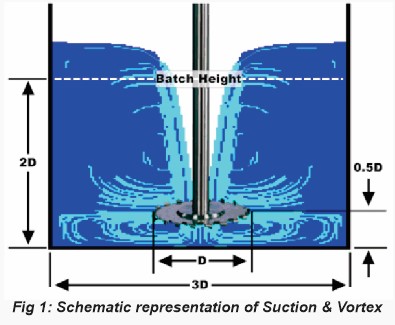
- Suction and Vortex: As the blade spins, it creates a powerful suction zone at the centre, drawing solids and liquids into the high-energy teeth.
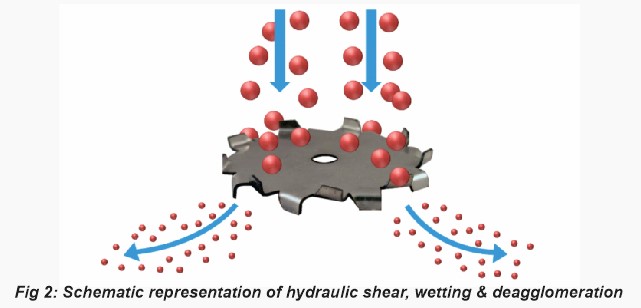
- Hydraulic Shear: The “intricacy” lies in the velocity gradient. The glue immediately adjacent to the blade moves at a high velocity, while the glue slightly further away moves slower. This difference creates a shear-force that tears apart clumps of extender flour, bark powder, or dried resin solids.
- Wetting and De-agglomeration: In plywood glue, “extenders” like maida flour are notorious for forming “fish-eyes” (clumps that are wet on the outside but dry on the inside). The Cowles blade provides the mechanical force necessary to burst these clumps, ensuring every particle is “wetted” by the Phenol-Formaldehyde (PF) or Urea-Formaldehyde (UF) resin. [See Fig 2.]
Key Benefits for Resin, Glue, and Bond Performance
Using a high-shear Cowles system offers three distinct advantages that directly impact the bottom line:
- Resin Efficiency
Because the mixer provides superior dispersion, the resin can coat the extenders and fillers more effectively. This often allows for a slight reduction in resin consumption (the most expensive component) without sacrificing the solids content of the glue.
2. Superior Glue Rheology
A well-mixed glue has “short” flow characteristics, meaning it spreads evenly across the veneer without dripping excessively or leaving “starved” spots. The Cowles Dissolver ensures a stable viscosity that resists “skinning” or premature thickening in the spreader.
- Enhanced Bond Performance
The strength of plywood depends on the resin’s ability to penetrate the wood fibres. If the glue contains micro-clumps of unmixed flour, these act as “weak points” in the glue line. High-shear mixing ensures molecular-level uniformity, leading to higher Wood Failure percentages in shear testing—the gold standard for plywood quality.
- Higher Moisture “Acceptance”
The precision of glue-mixing, which ensures that every particle of extender/filler is uniformly coated with the resin/binder – creating an “engineered” uniform particle size, highest possible “glue-particle” surface area, an optimum level of homogeneity – which helps the acceptance of higher moisture content in the core-veneer. The process creates maximum moisture-distribution-equilibrium across the raw mat-board during the prepress compaction time, thereby enabling higher moisture bond-line curing using appropriate process parameters.

Designing the Ultimate Glue Mixer
The design of a glue mixer is not arbitrary; it is a calculated balance of geometry and power. A poorly designed tank will result in “dead zones” where glue sits unmixed, leading to batches that vary in viscosity & dispersion, from top to bottom.
- Tank Geometry
The mixing vessel should ideally be cylindrical with a dished or sloped bottom to prevent material from stagnating in corners. The ratio of the tank diameter (D) to the blade diameter (d) is a critical design factor. Typically, a ratio of D/d = 2.5 to 3.0 is considered optimal for plywood glues.[See Fig 1.]
- The “Donut” Flow (The key physical confirmation)
In a correctly designed mixer, the glue should form a “donut” shape around the shaft. If the blade is too high, it draws in air (a situation called as vortexing), which can cause foaming – a nightmare for glue spreaders. If it is too low, the top of the batch remains stagnant.
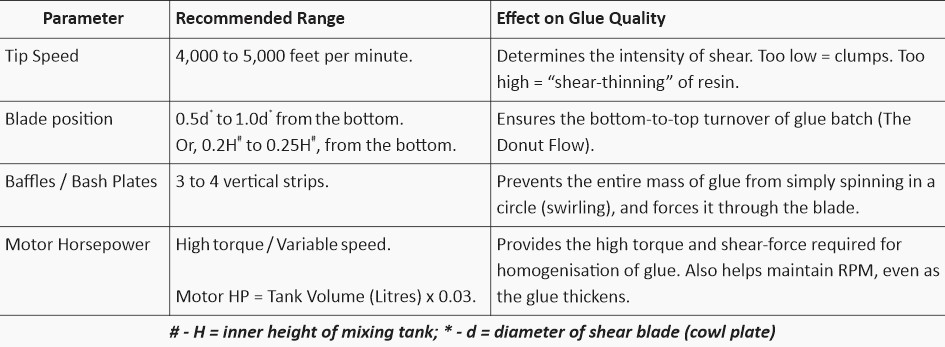
Critical Design Parameters and Their Effects
To achieve consistent glue quality, several parameters must be precisely engineered:

Tip Speed Calculation
The intensity of the mix is governed by the Tip Speed (St), calculated as:
St = Pi x d x RPM (where d = diameter of the blade)
Tip speed of the blade is crucial parameter in glue-mixing. Engineering the precise tip speed provides high quality glue, after the mixing process.
The Role of Baffles/Bash plates
Without baffles, the glue moves as a solid mass in a plain circular motion, known as “swirling”. Baffles break this laminar flow, creating turbulence that ensures every millilitre of glue eventually passes through the high-shear zone of the teeth. This is the secret to batch-to-batch consistency as well as homogenous particle-size.
Impact on Final Glue Quality
The intersection of these design parameters dictates the Stability, Pot Life, Coating efficiency, and Consistency of the glue.
- Consistency: A high-shear mix ensures that the specific gravity and viscosity remain uniform. This means the glue spreader settings don’t need to be adjusted mid-shift, reducing wastages & misguided complaints.
- Reduced Filtration Issues: Clumps can clog the spray nozzles or the curtain coater in modern plywood lines. In the standard roller glue-spreader, it helps maintain “short flow” characteristics, reduces missed glue spots, as well as increases consistency of high-moisture process.
- Temperature Control: High-shear mixing generates heat due to friction. A well-designed mixer might include a cooling jacket to ensure the resin does not “kick” (begin curing) inside the mixing tank, which would ruin the entire batch.
Conclusion
The Cowles Dissolver is more than just a bucket with a blade; it is a precision instrument for chemical dispersion. By optimizing the tip speed, tank geometry, and baffle configuration, plywood manufacturers can produce a glue that is not only cheaper to make but significantly more effective at bonding veneers. In an industry where margins are thin and quality is paramount, the intricacies of the glue loft/kitchen make all the difference. Manufacturers who study, realise, appreciate, and implement these engineering aspects, stand to gain life-changing product-improvements and confidence for themselves.
👇 Please Note 👇
Thank you for reading our article!
If you don’t received industries updates, News & our daily articles
please Whatsapp your Wapp No. or V Card on 8278298590, your number will be added in our broadcasting list.



 Hindi
Hindi 
Ply insight launched on March 2018 with a vision to make a platform to collaborate plywood MDF, Laminate, machinery manufactures with dealers in the Trade.
Categories
Useful Links
Follow Us