

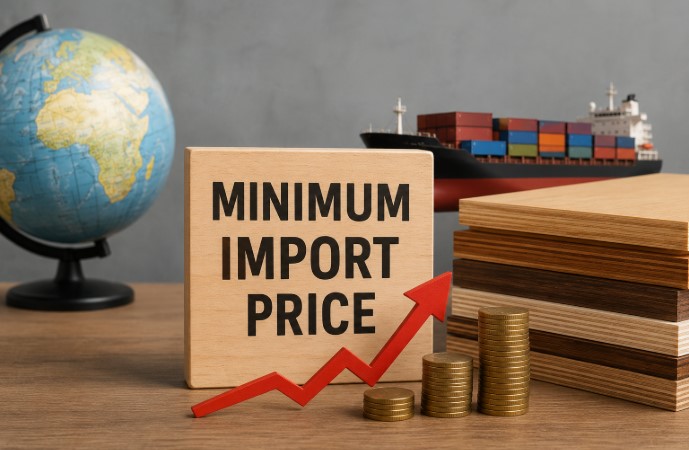
Minimum Import Price should be recommended
- June 9, 2026
- 0
At present, the panel industry is going through a very difficult phase. Market sentiments are extremely weak, and across India overall sales are hardly around 50%. At the same time, the industry is facing major challenges related to raw materials, labour shortages, and rising operational costs.
Our plywood and panel industry is heavily dependent on imports such as timber, core veneer, face veneer, and various chemicals. Without imports, it is very difficult for the industry to function smoothly.
As of today, I personally feel we should not be overly worried about imported plywood, because due to the USD impact and high logistics costs, imported plywood itself has become very expensive.
I would like to place a few humble suggestions:
- Minimum Import Price (MIP) on Imported Plywood
With the support of DPIIT and other concerned departments, we may consider implementing an MIP (Minimum Import Price) on imported plywood. If someone still wants to import at higher prices, they may continue to do so, but this can help protect domestic manufacturers from unfair price pressure.
- Strength of Indian Manufacturing
Today, India has a large number of technologically advanced plywood factories capable of manufacturing high-quality plywood for the furniture and interior industry. Our domestic manufacturing capability is now much stronger than before.
- Focus on Transportation Cost Reduction
One of the biggest concerns today is transportation cost within India. In many cases, transporting containers from Vietnam is cheaper than transporting goods domestically from places like Gandhidham or UP to South India. For example, transportation from Gandhidham/UP to South India for a 27-ton load is touching around ₹1,80,000.

We should collectively discuss with the concerned authorities and request improved railway freight infrastructure and wagon/container availability, especially for major manufacturing clusters such as: UP, Gandhidham, Kerala, Bihar and Haryana.
Even a 5% reduction in logistics cost can make a major positive impact on the industry. As we are aware, some port-based Indian factories are already using coastal/domestic sea routes to reduce transportation expenses.
- Faster BIS Implementation & Enforcement
It has been almost 18 months since BIS implementation started, but progress still appears very slow. As per industry understanding, only around 1,200 factories currently have active ISI licenses, while many others are still operating without proper compliance. If stronger monitoring and control are implemented, it can significantly improve the domestic market environment and create fair competition.
- Quality Control on Imported Material
We should also request the concerned departments to conduct random quality inspections of imported containers as per BIS standards. This will help maintain quality standards and ensure fair competition between domestic manufacturers and imports.
The above points are only humble suggestions for discussion and industry improvement.

👇 Please Note 👇
Thank you for reading our article!
If you don’t received industries updates, News & our daily articles
please Whatsapp your Wapp No. or V Card on 8278298590, your number will be added in our broadcasting list.
Follow our Whatsapp Channel “Ply & Panel Ind. News”



 Hindi
Hindi 
Ply insight launched on March 2018 with a vision to make a platform to collaborate plywood MDF, Laminate, machinery manufactures with dealers in the Trade.
Categories
Useful Links
Follow Us