

Useful Guide Book for Quality Control
- August 10, 2026
- 0
Knowledge of technology assists in the manufacturing of consumer products. The manufactured product must conform to standards and fulfill consumer requirements in its end use.
During the manufacturing process, the final product sometimes fails to meet all the required properties for its end use, which indicates that there is a flaw somewhere in the production process. Keeping these circumstances in mind, national standards are developed and implemented to ensure that products of guaranteed quality are manufactured and can fulfill their expected uses.
Among the various factors affecting the quality of the final product, the most prominent are the quality of raw materials and standard manufacturing processes. To ensure the quality of raw materials—including wood logs, veneers, and chemicals—strict monitoring and testing are essential so that raw materials of the required and uniform quality reach the production line before the production process begins.
The assessment of the final quality of a product can be done by testing the finished product and comparing the test results with prescribed standards and end-use requirements. In the case of plywood, the bonding strength, physical and mechanical properties, weather resistance, and resistance to biological degradation of the finished product are tested, and their results are compared with established standards.

If the test results do not conform to the established standards, the production team must investigate whether the cause is low-quality or degraded raw material or an error in the standard manufacturing process.
Knowledge of technology assists in the manufacturing of consumer products. The manufactured product must conform to standards and fulfill consumer requirements in its end use.
During the manufacturing process, the final product sometimes fails to meet all the required properties for its end use, which indicates that there is a flaw somewhere in the production process. Keeping these circumstances in mind, national standards are developed and implemented to ensure that products of guaranteed quality are manufactured and can fulfill their expected uses.
Among the various factors affecting the quality of the final product, the most prominent are the quality of raw materials and standard manufacturing processes. To ensure the quality of raw materials—including wood logs, veneers, and chemicals—strict monitoring and testing are essential so that raw materials of the required and uniform quality reach the production line before the production process begins.
The assessment of the final quality of a product can be done by testing the finished product and comparing the test results with prescribed standards and end-use requirements. In the case of plywood, the bonding strength, physical and mechanical properties, weather resistance, and resistance to biological degradation of the finished product are tested, and their results are compared with established standards.
If the test results do not conform to the established standards, the production team must investigate whether the cause is low-quality or degraded raw material or an error in the standard manufacturing process.
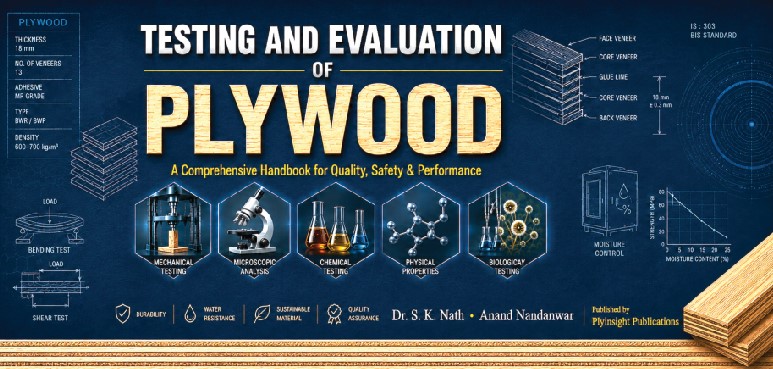
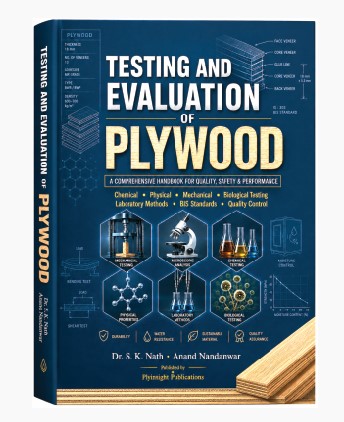
This book covers all essential in-house tests for raw materials, intermediate products, and finished plywood. It will guide trainees and technicians working in plywood factories and testing laboratories in performing all necessary tests required for plywood manufacturing and final products. All tests have been scientifically designed in accordance with national and international standards.

In addition to traditional testing methods, the book includes several extra tests that are useful and rapid for online quality evaluation of plywood during quality control and production.
Thus, this book will prove to be a useful guide for chemists and quality control officers working in the plywood industry for daily quality maintenance and for verifying the conformity of factory products with national and international standards.
👇 Please Note 👇
Thank you for reading our article!
If you don’t received industries updates, News & our daily articles
please Whatsapp your Wapp No. or V Card on 8278298590, your number will be added in our broadcasting list.
Join our WhatsApp Channel “Ply & Panel Ind. News”



 Hindi
Hindi 
Ply insight launched on March 2018 with a vision to make a platform to collaborate plywood MDF, Laminate, machinery manufactures with dealers in the Trade.
Categories
Useful Links
Follow Us