

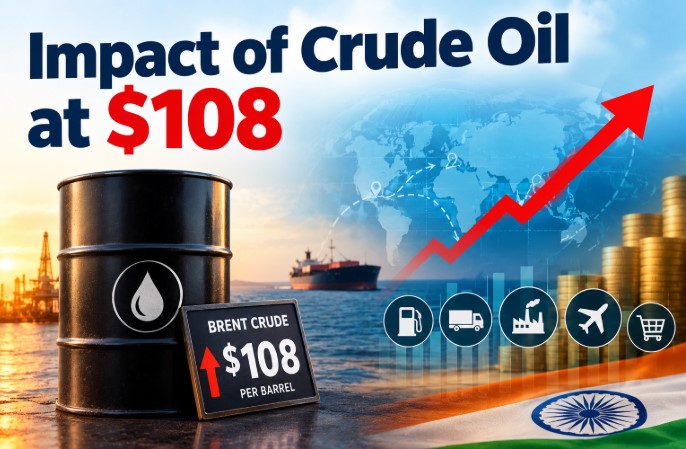
Impact of crude oil @$108
- September 16, 2026
- 0
Yemen’s Iran-backed Houthi rebels have captured some more strategic islands in the southern Red Sea, according recent news. Like the Strait of Hormuz, located at the mouth of the Persian Gulf, the Bab el-Mandeb Strait, on the opposite side of the Arabian Peninsula, is also a crucial maritime chokepoint. It connects the Red Sea with the open ocean and serves as an important shipping route for access to Saudi Arabia’s major Asian markets.
The shutdown of the pipeline, which helps Saudi Arabia bypass the Strait of Hormuz and reroute its oil exports through the Bab el-Mandeb Strait, could put up global oil supplies at risk.
As a result, the price of Brent crude, a major benchmark for crude oil, has risen to around $108 per barrel. India imports more than 85% of its crude oil requirements. Therefore, a rise in crude oil prices is a matter of concern for the Indian economy.
Crude oil is considered an “input cost” for the entire economy. Its use is not limited to petrol, diesel and LPG; several sectors, including transportation, manufacturing, chemicals and aviation, are directly linked to crude oil.
Challenges
Trade deficit: India is forced to spend more dollars even to import the same quantity of crude oil, widening the gap between imports and exports.
Current account deficit: A higher oil import bill increases the current account deficit. According to estimates, if crude oil remains at $100 per barrel, the current account deficit could rise to 1.9%–2.2% of GDP.
Fiscal deficit: If the higher cost is passed on to consumers, inflation rises. If the government absorbs the shock by reducing excise duties or providing subsidies, it puts pressure on the fiscal deficit.

Impact on Inflation: Higher diesel prices increase freight and transportation costs, making everything more expensive from food products to daily-use goods. According to the RBI, a $10-per-barrel increase in crude oil prices could raise inflation by around 49 basis points (0.49%).
Pressure on the rupee: A higher import bill increases demand for dollars, which can weaken the rupee. A weaker rupee makes other imports more expensive as well, further adding to inflationary pressures.
Foreign investor selling: Rising oil prices, higher inflation and fears of weaker corporate earnings could prompt Foreign Portfolio Investors (FPIs) to withdraw capital from the Indian stock market.
How Serious Is the Crisis?
The $108-per-barrel level by itself does not constitute a serious macroeconomic crisis. India has adequate foreign exchange reserves, and the current account deficit has remained under control in recent times.
However, if crude oil prices remain above $100 per barrel for several months, or if supply chains in West Asia are disrupted, the situation could significantly upset the balance between economic growth and inflation.
👇 Please Note 👇
Thank you for reading our article!
If you don’t received industries updates, News & our daily articles
please Whatsapp your Wapp No. or V Card on 8278298590, your number will be added in our broadcasting list.
Join our WhatsApp Channel “Ply & Panel Ind. News”



 Hindi
Hindi 
Ply insight launched on March 2018 with a vision to make a platform to collaborate plywood MDF, Laminate, machinery manufactures with dealers in the Trade.
Categories
Useful Links
Follow Us