

Need to improve financial capability among households
- August 12, 2026
- 0
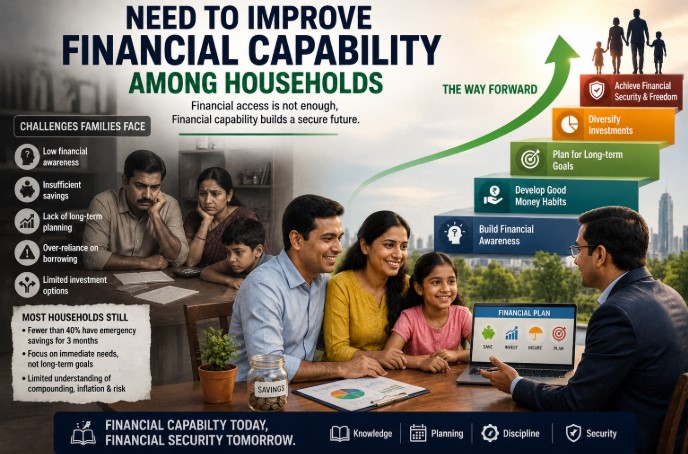
India has made major progress in financial inclusion over the past decade through bank account expansion, digital payments, and easier access to credit and insurance. However, despite this success, many households still lack financial maturity — the ability to make informed, long-term, and resilient financial decisions.
A study by IIM Udaipur and PRICE highlights that while people now have access to financial services, they often struggle with understanding concepts such as compounding, inflation, risk diversification, and long-term financial planning. Many families continue to rely on informal coping methods like borrowing from relatives, selling assets, or taking costly loans during financial stress.
The report reveals that fewer than 40% of households have emergency savings sufficient for three months of expenses. Most people prefer saving over unnecessary spending, but structured financial planning — especially for retirement — remains weak. Households generally prioritize immediate needs like education, healthcare, and consumption over long-term wealth creation.

The study also notes that financial behaviour is influenced not only by income but also by awareness, education, and access to information. Younger and more educated individuals tend to demonstrate better financial understanding and planning.
Another key finding is the lack of financial diversification. Most households continue to depend mainly on traditional assets such as bank deposits, gold, and real estate, while participation in equity and market-linked investments remains limited to higher-income groups.
Policymakers should move beyond measuring only financial access and focus more on building financial capability. Financial education should address behavioural barriers like low confidence, complexity, and lack of trust.
India’s financial inclusion journey has been transformative, but true economic progress now depends on improving financial capability and helping households confidently navigate the financial system.
👇 Please Note 👇
Thank you for reading our article!
If you don’t received industries updates, News & our daily articles
please Whatsapp your Wapp No. or V Card on 8278298590, your number will be added in our broadcasting list.
Join our WhatsApp Channel “Ply & Panel Ind. News”



 Hindi
Hindi 
Ply insight launched on March 2018 with a vision to make a platform to collaborate plywood MDF, Laminate, machinery manufactures with dealers in the Trade.
Categories
Useful Links
Follow Us