

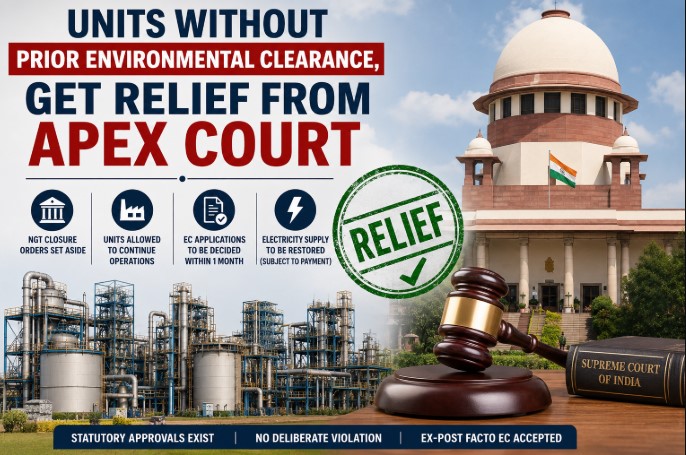
Units without Prior Environmental clearance, get relief from Apex court
- May 8, 2026
- 0
In a significant judgment for the plywood, laminate, and panel industries, the Supreme Court has set aside the National Green Tribunal (NGT) orders that directed the closure of several formaldehyde and Resin manufacturing units in Rajasthan and Haryana for operating without prior Environmental Clearance (EC).
Supreme Court’s Observation
A Bench comprising Justice J.K. Maheshwari and Justice Atul S. Chandurkar observed that the industries had not intentionally violated environmental laws or acted without bona fide intent.
The Court noted that: “This is not a case where the industries established units and commenced operations by deliberately ignoring legal requirements. Rather, even the Pollution Control Boards themselves were uncertain whether prior Environmental Clearance was required under the EIA Notification, 2006.”
The Bench further observed that the units had already applied for Environmental Clearance after receiving notices from the respective Pollution Control Boards (PCBs), and those applications are currently pending.
Background of the Case
The case arose from multiple original applications filed before the National Green Tribunal alleging that formaldehyde manufacturing units were operating without obtaining prior Environmental Clearance under the Environment Impact Assessment (EIA) Notification, 2006.
The NGT, through orders dated 03.06.2021, held that such units could not operate without prior EC and directed their closure. The tribunal relied on its earlier judgment in Dastak NGO v. Synochem Organics Pvt. Ltd.
The affected units subsequently challenged these closure orders before the Supreme Court.
Reliance on Pahwa Plastics Judgment
During the proceedings, the Supreme Court referred extensively to its earlier landmark ruling in Pahwa Plastics Pvt. Ltd. v. Dastak NGO (2023), where similar NGT closure orders had already been set aside.
In the Pahwa Plastics case, the Court had ruled that:
- industries operating with valid Consent to Establish (CTE) and Consent to Operate (CTO), granted by statutory authorities, should not be shut down merely because prior Environmental Clearance was not obtained, especially when the Pollution Control Boards themselves were unclear regarding the applicability of EC requirements.
Pollution Control Boards Were Also Uncertain
The Supreme Court noted that: Rajasthan Pollution Control Board issued an office order dated 19.08.2019, while Haryana Pollution Control Board issued a similar order dated 10.11.2020, directing already operational formaldehyde units to apply for Environmental Clearance within a specified period.
The Court recorded that all appellant units complied with these directions and submitted their EC applications within the stipulated timeframe.
Progress of Environmental Clearance Applications

The Bench also examined the current status of the EC applications and observed that:
- Screening and scoping processes had already been completed,
- Terms of Reference (ToR) had been granted,
- Public consultation requirements were exempted in many cases as the units were located in industrial areas,
- In some cases, public hearings were completed and only final appraisal remained pending.
Economic & Industrial Importance
The Supreme Court emphasized that the matter involved already operational industries contributing to: employment generation, industrial production, and economic activity.
The Court reiterated the observation made in the Pahwa Plastics judgment:
“A unit contributing to the economy and providing livelihood to hundreds of people should not be closed down merely due to the technical irregularity of absence of prior Environmental Clearance.”
The Bench further clarified that: “Ex-post facto Environmental Clearance should not ordinarily be granted casually, but at the same time cannot be denied with rigid technicality regardless of economic consequences.”
Court Rejects Closure Approach
The Court rejected arguments suggesting that the Pahwa Plastics judgment applied only to units employing approximately 8000 workers. It clarified that the earlier observations collectively covered the formaldehyde manufacturing sector, including the present appellant units.
The Bench also rejected objections relating to deemed consent provisions under environmental laws, observing that the units had in fact received Consent to Operate from the Pollution Control Boards.
Importantly, the Court stressed that:
- the industries were operating with statutory permissions,
- and this was not a case of deliberate environmental violation.
Final Verdict
The Supreme Court ultimately concluded that:
“Ex-post facto Environmental Clearance was the appropriate corrective mechanism initiated upon directions of the respective Pollution Control Boards.”
Accordingly, the Court:
- Set aside the NGT closure orders,
- Allowed the units to continue operations,
- Directed authorities to decide pending EC applications within one month,
- Ordered restoration of electricity supply wherever disconnected, subject to payment of dues.
However, the Court clarified that if any EC application is ultimately rejected due to violations attributable to the units, authorities would remain free to take action in accordance with law.
👇 Please Note 👇
Thank you for reading our article!
If you don’t received industries updates, News & our daily articles
please Whatsapp your Wapp No. or V Card on 8278298590, your number will be added in our broadcasting list.



 Hindi
Hindi 
Ply insight launched on March 2018 with a vision to make a platform to collaborate plywood MDF, Laminate, machinery manufactures with dealers in the Trade.
Categories
Useful Links
Follow Us