

Smaller the Brand, Bigger the Pain
- June 9, 2026
- 0
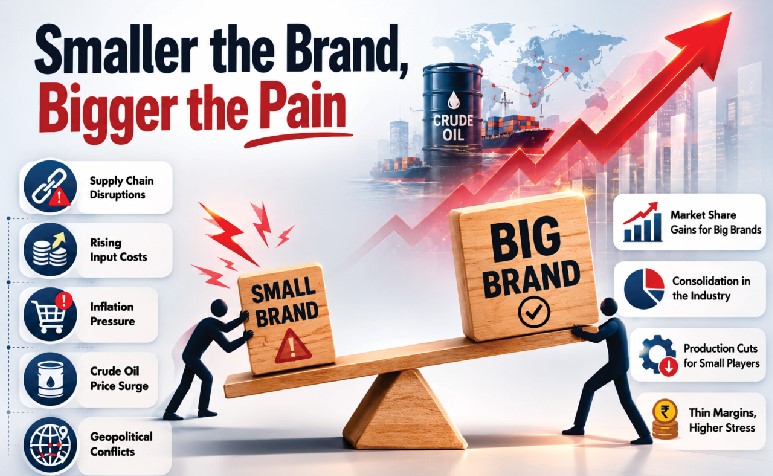
Industries are unanimous that supply chain disruptions and rising input costs hurt smaller companies more, while big companies tend for accelerating market share gains and consolidation.
volatility triggered by higher crude prices, inflation and supply disruptions linked to the US-Iran-Israel conflict have increased pressure on smaller firms that lack inventory buffers and sourcing muscle. More than supply chain bottlenecks, the rising inflation is also hurting the smaller players.
Bigger companies, on the back of their brand power, can pass on the inflation to consumers but the smaller companies do not have that headroom, which eventually impact them and their margins.
The US-Iran-Israel conflict and oil shipping disruptions have added to market uncertainty, forcing companies to rethink sourcing and inventory strategies.
Small companies face immediate supply constraints, which is growing stress among them, some of whom have already curtailed production because of sourcing difficulties.
The pressure is visible with every manufactures, who are facing rising raw material costs along with currency volatility. Bigger brands have an advantage when there is “tremendous stress” on supply chains.

Larger brands are better placed to manage disruptions, smaller companies have to pass on the production cost increase instantly, but larger companies can absorb it for some time.
In the times of turmoil, bigger brands have sustaining power. Smaller companies operate on thin margins which makes it difficult to survive when raw material prices are frequently going up,
Large brands are gaining market share “by burning money” while smaller brands are struggling to adapt to the global turmoil. The top 5-6 brands gained 5-6 percentage points of market share sequentially in the last quarter. Even as India’s overall market fell 4-5%.
More than half a dozen smaller brands have suspended or curtailed to half their production in recent months, source said.
During a crisis, the strong gets stronger and the weak gets weaker. Protection against inflation also mean your ability to stock up.
It’s a question of working capital.
👇 Please Note 👇
Thank you for reading our article!
If you don’t received industries updates, News & our daily articles
please Whatsapp your Wapp No. or V Card on 8278298590, your number will be added in our broadcasting list.
Join our Whatsapp Channel “Ply & Panel Ind. News”




 Hindi
Hindi 
Ply insight launched on March 2018 with a vision to make a platform to collaborate plywood MDF, Laminate, machinery manufactures with dealers in the Trade.
Categories
Useful Links
Follow Us