

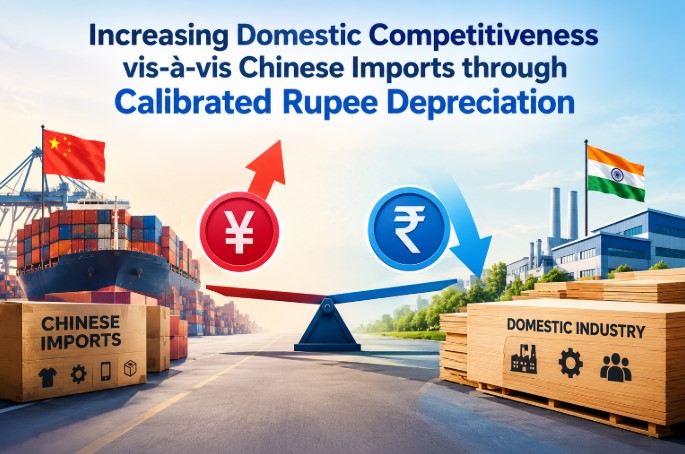
Increasing domestic competitiveness vis-a-vis Chinese imports through calibrated rupee depreciation
- October 16, 2026
- 0
Depreciation of the rupee vis-à-vis the dollar has raised some anxiety in markets.
It should not. From an economic perspective, it’s very important not to conflate a strong currency with a strong economy. Instead, measured rupee depreciation is both inevitable, and desirable, in the current macro environment.
Exchange rates are typically meant to be an economy’s “shock absorber” to external pressures or changing economic fundamentals so that other variables in the economy don’t have to undergo disruptive changes.
If movements in the exchange rate can help equilibrate “external balances”, monetary and fiscal policy is freed up to focus on trying to achieve “internal balance”.
China is beset with a large excess capacity. After the US increased tariffs on China, the latter has increasingly been redirecting its exports to the rest of the world. Already, India’s imports from China and Hong Kong have been rising in a secular manner such that India’s bilateral trade deficit with China/Hong Kong has almost doubled from $58 billion before the pandemic to $114 billion in 2024-25.
On its part, the rupee in nominal terms depreciated by more 15 per cent against the Chinese yuan since the pandemic. Yet because of Chinese deflation, the real exchange rate against China has appreciated by 10 per cent during that time, making Chinese imports commensurately cheaper in real terms.
Letting the currency depreciate vis-à-vis the yuan will make Chinese imports more expensive and domestic substitutes more competitive. Furthermore, this is preferable to putting a tariff on Chinese imports because the latter discriminates against exports while the exchange rate is neutral to both importers and exporters.
In summary
For all these reasons, It’s important not to resist rupee depreciation.



 Hindi
Hindi 
Ply insight launched on March 2018 with a vision to make a platform to collaborate plywood MDF, Laminate, machinery manufactures with dealers in the Trade.
Categories
Useful Links
Follow Us