

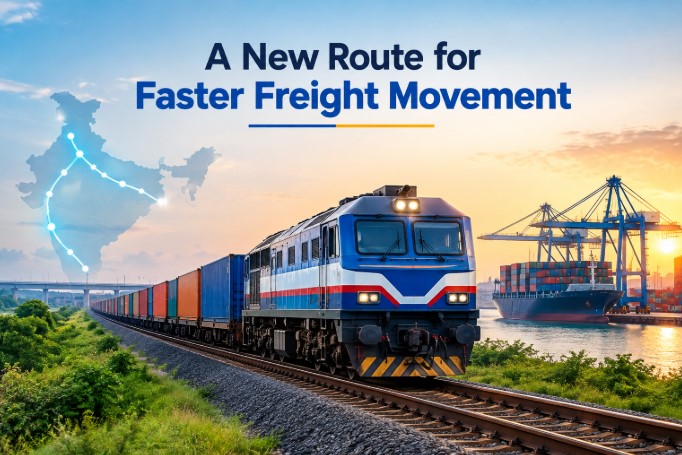
A New Route for Faster Freight Movement
- October 16, 2026
- 0
Prime Minister Narendra Modi dedicated the ₹73,000-crore Western Dedicated Freight Corridor (DFC) to the nation on September 8, bringing to an end a nearly 20-year-old chapter in India’s infrastructure history. The corridor extends over 2,800 kilometres and has witnessed the tenures of three prime ministers.
The Western DFC, connecting Dadri in Uttar Pradesh with the Jawaharlal Nehru Port Authority (JNPA), is expected to save around 60% of the time compared with a train travelling through Indian Railways’ conventional routes.
Experts estimate that the corridor could reduce costs for container cargo by around 25%, compared with the current savings of only about 6–7% achieved through rail transportation.
The Eastern DFC, running through Punjab and Bihar, was completed in October 2023 at a cost of around ₹51,000 crore. The combined cost of the two corridors, upon completion, stood at approximately ₹1.24 lakh crore. The initial plan had estimated the final cost at only about one-sixth of this amount.
For simplicity, the Western DFC is often described as an industrial corridor, connecting major ports such as Mundra, Kandla, Pipavav and JNPA with several industrial cities in northern and north-western India.
According to officials, an average journey of 100 kilometres on the Western DFC takes around 2 hours and 30 minutes, compared with nearly six hours on conventional railway tracks.
Most of the Western DFC had been completed several years ago, but the final critical section connecting it to JNPA in Maharashtra was delayed.
Its completion is expected to give the government-owned JNPA an advantage that competing private ports such as Mundra and Pipavav have enjoyed for several years.
The section underwent a trial run on June 30 and has now been operational for around a month.
Container train operators, who are expected to be among the biggest beneficiaries of the JNPA connectivity and completion of the corridor, have welcomed the development. However, concerns remain regarding the corridor’s efficiency and the actual savings it will deliver.
Although the overall cost saving is estimated at only around 6–7%, one reason is that containers loaded on the upper stack are charged at 50% of the price applicable to the box placed on the lower stack.



 Hindi
Hindi 
Ply insight launched on March 2018 with a vision to make a platform to collaborate plywood MDF, Laminate, machinery manufactures with dealers in the Trade.
Categories
Useful Links
Follow Us