

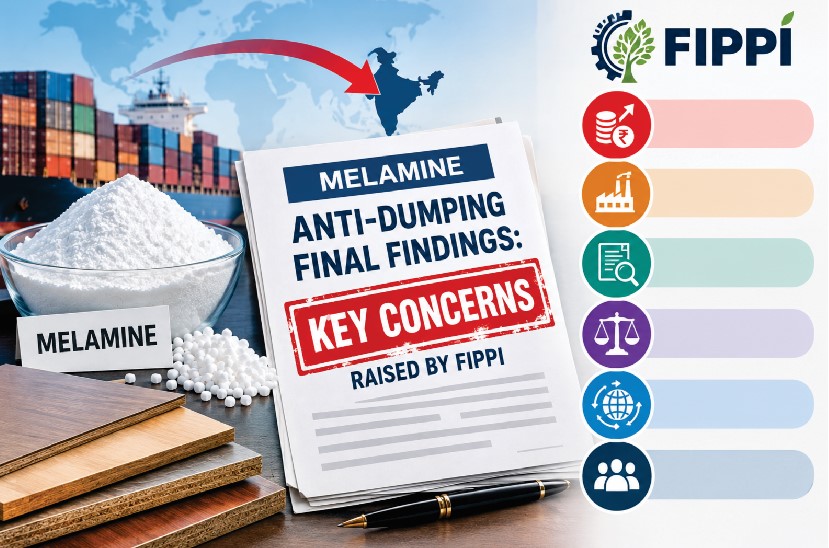
Melamine Anti-Dumping Final Findings: Key Concerns Raised by FIPPI
- October 16, 2026
- 0
The Directorate General of Trade Remedies (DGTR), in its final findings dated 28 September 2026 in Case No. AD (OI) 35/2025, has recommended definitive anti-dumping duty for five years on Melamine imports from China PR. The proposed duty ranges from US$ 245 to US$ 403 per MT, equivalent to around 25–42% of the landed price. The investigation was initiated on the application of Gujarat State Fertilizers and Chemicals Ltd. (GSFC), India’s sole domestic Melamine producer.
In her submission to the DGTR, Vasudha Singh, Advocate, Supreme Court, stated that the final findings contain “legal and factual infirmities” and that the determination of injury is not adequately supported by the data presented by the Authority itself.
Key Legal Concerns
A major concern is the non-disclosure of essential facts, particularly the exact Normal Value, Export Price, Dumping Margin and Non-Injurious Price. Earlier judgments of the Gauhati High Court in the Century Plyboards case concerning Melamine held that such essential figures cannot be kept completely confidential under Rules 7 and 16 of the Anti-Dumping Rules. The subsequent legal proceedings did not disturb this position.
The construction of Normal Value is also questionable. Under Annexure I, Paragraph 7, the Authority is required to first consider data from a market-economy third country before adopting an alternative methodology. The Authority moved to the residual method because third-country data was not submitted by interested parties, even though the obligation to examine appropriate data rests with the Authority.
Another major issue is objective examination and non-attribution. Factors other than Chinese imports—including global price declines, suspension of Plants I and II, changes in GSFC’s export strategy and imports from third countries—were not adequately quantified or separated from the alleged injury caused by China PR.
The public-interest aspect is also questionable. The Central Government had earlier decided not to impose anti-dumping duty on Chinese Melamine in October 2021. In addition, Customs Notification No. 12/2026 reduced customs duty to nil on several inputs in the Melamine value chain. These policy decisions should have been considered while assessing the broader public interest.
Authority’s Own Figures Raise Questions
Price undercutting is negative, yet the Authority relied on price depression. According to the Authority’s own figures, GSFC’s price in 2022-23 was approximately ₹1,04,200 per MT, compared with a landed import price of ₹1,15,559 per MT. GSFC’s price therefore remained below the import price, making it difficult to establish that Chinese imports had depressed domestic prices.
From 2022-23 onwards, GSFC’s selling price declined by 22%, while its cost of sales declined by 21%. At the same time, subject imports increased by 51%. The critique argues that GSFC’s prices therefore broadly followed its own costs rather than being driven down by imports.
The Normal Value is stated at ₹85,430–93,973 per MT, while GSFC’s cost of sales during the investigation period was approximately ₹88,200 per MT. The argument given is that Normal Value itself broadly corresponds to the domestic industry’s cost, raising questions about whether the same price comparison is effectively being used to establish dumping, price injury and causation.
Capacity and Residual Duty
GSFC’s Plant III produced 42,452 MT, exceeding its rated capacity of 40,000 MT. Around three-fifths of the increase in Chinese imports could be explained by demand growth and declining imports from third countries.
The proposed residual duty of US$ 403 per MT is another major concern. Against a Non-Injurious Price of US$ 1,100–1,200 per MT, the duty appears to assume a landed import price of only US$ 697–797 per MT for non-cooperating producers. However, disclosed figures indicate landed prices of approximately US$ 964–1,011 per MT, which would imply an injury margin of only around US$ 89–236 per MT.
At an annual import volume of approximately 85,000 MT, the difference could amount to roughly ₹122–229 crore annually.
Conclusion
It concludes that anti-dumping duty is intended to address unfair trade, not to shield a domestic producer from ordinary competition or from the consequences of its own cost structure.
It calls for greater transparency, disclosure of essential facts, objective assessment of injury and causation, proper consideration of alternative factors and stronger public-interest analysis in India’s trade-remedy proceedings.
The central concern is that a measure intended to restore fair competition could, if based on insufficiently supported findings, instead restrict competition and impose significant costs on downstream industries and ultimately consumers.


 Hindi
Hindi 
Ply insight launched on March 2018 with a vision to make a platform to collaborate plywood MDF, Laminate, machinery manufactures with dealers in the Trade.
Categories
Useful Links
Follow Us