

New income tax laws: Where New Law Applies, and Old One Survives
- May 11, 2026
- 0
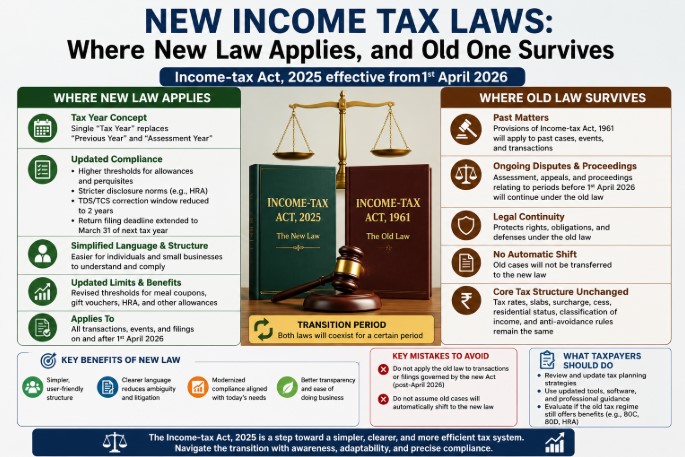
India is set to usher in a major tax reform with the implementation of the Income-tax Act, 2025, effective from April 1, 2026. This new legislation will replace the long-standing Income-tax Act, 1961, marking a significant step toward modernization and simplification of the country’s tax framework.
However, the transition will not be immediate or absolute. For a certain period, both the old and new laws will coexist, making it essential for taxpayers and professionals to clearly understand their applicability.
What Changes Under the New Law
One of the most notable reforms is the introduction of a single “tax year”, replacing the earlier concepts of previous year and assessment year. This move aims to simplify tax terminology and reduce confusion for taxpayers.
The new Act also brings updated compliance requirements, including:
- Higher thresholds for allowances and perquisites
- Stricter disclosure norms, particularly for components like House Rent Allowance (HRA)
- Reduction in the correction window for TDS/TCS to 2 years
- Extension of the return filing deadline to March 31 of the next tax year
These changes are designed to align tax practices with modern economic realities and improve transparency.
What Remains Unchanged
Despite structural changes, the core foundation of taxation remains intact. There are no major changes in tax rates, slabs, surcharge, or cess.
Key principles such as:
- Residential status
- Classification of income
- Anti-avoidance rules
Will continue as before. Additionally, the provisions of the 1961 Act will still apply to past cases and ongoing disputes, ensuring legal continuity and protection for taxpayers.

Benefits of the New Law
- The new Income-tax Act focuses heavily on simplification and clarity. Its benefits include:
- A more user-friendly structure, especially for individuals and small businesses
- Simplified language to reduce ambiguity and litigation
- Updated limits for benefits such as meal coupons, gift vouchers, HRA, and other allowances
Overall, the reform aims to make compliance easier while reducing interpretation disputes.
Transitional Challenges
While the new law promises long-term ease, the transition phase may be complex. Taxpayers and professionals will need to adapt to:
- A new system of terminology and compliance
- Dual applicability of laws—new law for current filings, and old law for past matters
This overlap could temporarily increase compliance challenges and require careful handling.
- How Taxpayers Can Benefit
- To make the most of the new framework, taxpayers should:
- Review and adjust their tax planning strategies
- Use updated tools, software, and professional guidance
- Evaluate whether the old tax regime still offers advantages, especially for those claiming deductions like 80C, 80D, and HRA
Key Mistake to Avoid
- A critical error to avoid during this transition is misapplication of laws:
- Do not apply the old law to transactions or filings governed by the new Act (post-April 2026)
- Do not assume that old cases will automatically shift to the new law
Understanding the correct applicability is essential to avoid penalties and compliance issues.
Conclusion
The Income-tax Act, 2025 represents a progressive step toward a simpler, clearer, and more efficient tax system.
However, the coexistence of both old and new laws during the transition period demands careful navigation and informed decision-making. For taxpayers and professionals alike, success in this phase will depend on awareness, adaptability, and precise compliance.
👇 Please Note 👇
Thank you for reading our article!
If you don’t received industries updates, News & our daily articles
please Whatsapp your Wapp No. or V Card on 8278298590, your number will be added in our broadcasting list.
Join our Whatsapp Channel “Ply & Panel Ind. News”




 Hindi
Hindi 
Ply insight launched on March 2018 with a vision to make a platform to collaborate plywood MDF, Laminate, machinery manufactures with dealers in the Trade.
Categories
Useful Links
Follow Us