


Timber Import is Short Term Solution only
- November 14, 2026
- 0
- Demand and supply of timber
India’s plywood and panel industry is emerging as an important component of the country’s rapidly expanding wood-based manufacturing sector, driven by increasing demand from housing, infrastructure, furniture and interior applications. However, the future growth and competitiveness of the industry will depend critically on the availability of adequate, affordable and sustainable supplies of industrial wood.
According to the Federation of Indian Plywood and Panel Industry (FIPPI), the plywood sector remains highly fragmented, with nearly 80% of production accounted for by the unorganised sector and only about 20% by the organised sector. The industry comprises around 3,132 units and provides direct employment to more than 10 lakh people.
The ICFRE has projected the demand for plywood and related wood-based products at about 700 lakh cubic metres in round wood equivalent (RWE). In addition, India has about 47 particle board and 12 medium-density fibreboard (MDF) manufacturing units, which together consume about 90 lakh cubic metres of wood (RWE).
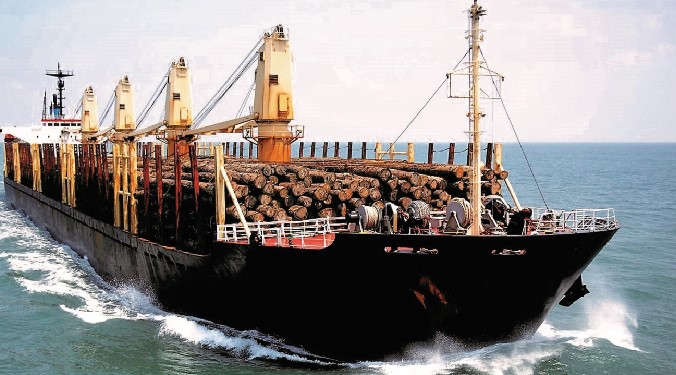
With the expansion of manufacturing capacity and rising demand for wood-based products, ensuring a reliable long-term supply of industrial wood has become a strategic challenge for the sector. High domestic wood prices and inadequate availability of suitable raw material have already resulted in increasing dependence on imports of pine, poplar, eucalyptus, veneers and other wood products.
While imports can help meet short-term supply gaps, they cannot provide a sustainable long-term solution. The central challenge, therefore, is to substantially increase domestic production of industrial wood, particularly through agroforestry and by developing long-term partnerships among farmers, industry and government.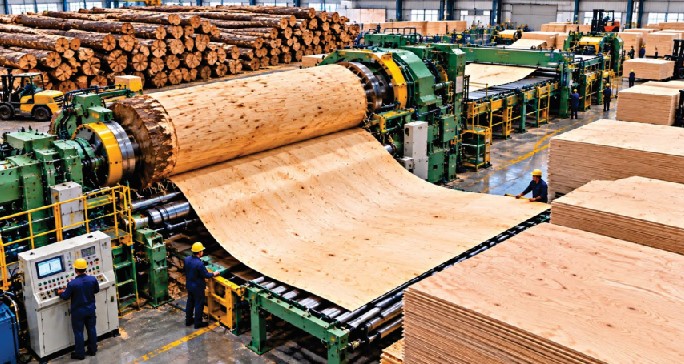
- Imports Do not Solve the Problem
Imports can serve as a useful buffer to meet temporary shortfalls in domestic wood availability, but they should not become the structural foundation of India’s plywood and panel industry.
Whenever domestic prices rise, importing veneer, logs and wood panels may appear to be the easiest solution. However, excessive dependence on imports exposes the industry to exchange-rate fluctuations, rising freight costs, volatility in international timber prices, geopolitical disruptions, port congestion and emerging carbon-related trade barriers.
More importantly, imported wood does not generate the broad rural economic multiplier that can be created through agroforestry. Every cubic metre of wood produced domestically generates economic activity and income across an extended value chain: farmer, farm labour, harvesting contractor, transporter, trader, processor, panel industry.
A sustained expansion of domestic wood production, therefore, would not only improve the availability and price stability of raw material for the industry but also create rural employment, diversify and enhance farm incomes, strengthen local value chains and reduce India’s dependence on imported wood and wood products.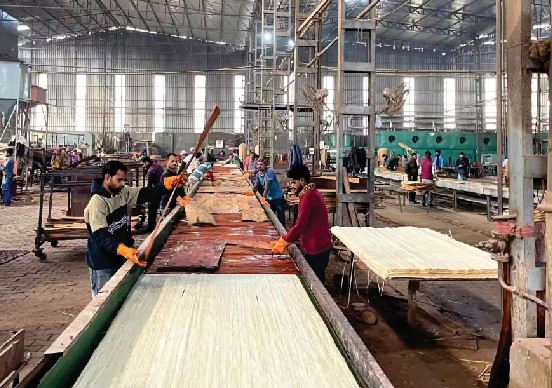
- Increasing the Production of Industrial Wood
3.1 Past Experiences of Wood-based Industry
India already has successful examples of addressing raw-material shortages through integrated models linking agroforestry with wood-based industry. WIMCO pioneered the promotion of poplar-based agroforestry in 1984 by supplying quality plants, facilitating access to institutional finance, developing packages of practices and offering buy-back arrangements. Similarly, ITC Bhadrachalam Ltd. promoted the cultivation of clonal eucalyptus, casuarina and subabul since 1989.
Its initiatives in the development of quality plants, along with technical support, encouraged the widespread adoption of clonal eucalyptus in different parts of the country. These experiences clearly demonstrate that integrated models can significantly increase the production of industrial wood. Such industry-farmer partnerships are, therefore, essential for ensuring the long-term sustainability and raw-material security of the wood-based industry.
3.2 Present Efforts of Plywood and Panel Industry
Several leading companies including CenturyPly, Greenply, Rushil Décor, have already initiated programmes to support farmers and promote agroforestry.
These initiatives include the supply of subsidised clonal plants, technical advice, extension support, delivery of plants and assistance in the procurement of timber.
In some cases, companies have also provided price assurance mechanisms to reduce market risks for farmers.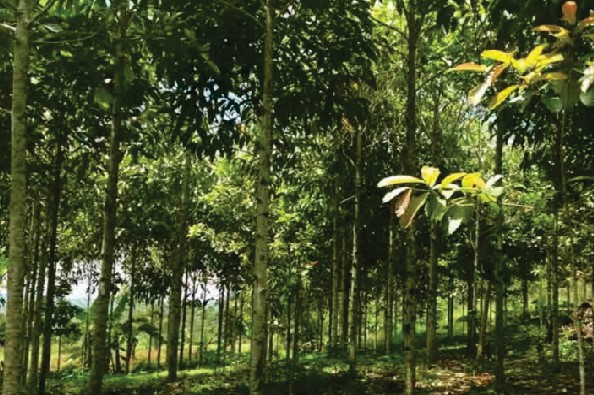
These initiatives demonstrate that well-designed farmer-industry partnerships can help in increasing the production of industrial wood.
A significant step in this direction has recently been taken by the FIPPI, which has signed a MOU with the Indian Council of Forestry Research and Education (ICFRE) for a project “Evaluation and Extension of Clones/Varieties Developed by ICFRE for the Plywood and Panel Industry.
” This initiative aims to evaluate suitable high-yielding clones and varieties and facilitate their large-scale extension to farmers. Such collaborative efforts can play an important role in strengthening the long-term sustainability and raw-material security of India’s plywood and panel industry.
- Initiatives Required
4.1 Plywood and Panel Industry
Every large company should move from procurement to “Wood-supply Development Plan”. The companies should become partners in creating their own future raw-material base. They should prepare a 10-15-year Wood Security Plan. Following actions need to be taken by them.
i. Long-term Contracts with Farmers
Every major company should adopt 10,000-50,000 farmers and should have wood supply agreements.; instead of merely approaching farmers when trees are ready for harvesting, major companies should provide planting material; technical advice; harvesting services; transport; and an assured market. This is much more powerful than simply giving a subsidy for plantation. 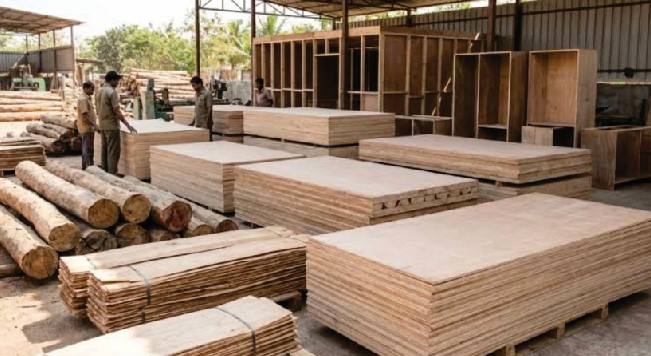
ii. “Wood Baskets” Around Clusters of Wood-based Industries
Around every major plywood and panel industry cluster, the industry should develop a “Wood Basket” within a radius of 100-150 km, where industrial agroforestry is systematically promoted.
This approach would enable investors to address a critical question before establishing manufacturing facility: “Where will the required wood come from over the next 20 years?”
The availability of a sustainable raw-material supply should, therefore, be made a key prerequisite for approving new capacity or expanding existing plywood and panel manufacturing facilities.
iii. Captive Plantations
Large plywood and panel companies should consider establishing “Captive Wood Plantations” on degraded private land; leased land; community land; and farm partnerships. However, the existing productive agricultural land should not be diverted indiscriminately. The emphasis should be on additional wood production, not competition with food production.
iv. Wood Development Fund
The Plywood and Panel Industry is mainly concentrated in the unorganised sector; hence small units can not directly support the farmers. Hence, FIPPI should motivate the industry through plywood associations to create a fund through a small contribution from every cubic metre of plywood produced which may finance R&D; extension services; and plantation development.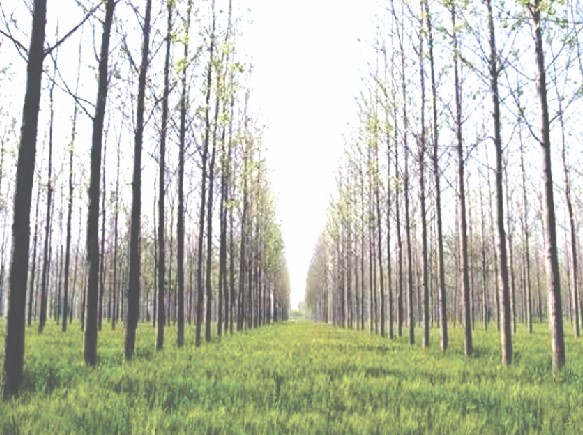
v. Tree Income Parity
The plywood and panel industry needs to ensure that the income from tree crops should be in top three alternatives of farm crops through price adjustment of industrial wood for maintaining the interest of farmers in tree farming.
vi. Tree Transition Incentive:
India has 86% of farmers in marginal and small categories, hence the large companies may promote agroforestry among them through raising block plantations in their farmlands from CSR funds. The income from tree plantations may be shared between farmers and panchayat in the ratio of 60:40. The panchayats may use this fund for the carrying out development works in their villages.
4.2 Government
The Government of India has launched the Aatmanirbhar Bharat Abhiyan to reduce import dependency of industrial wood and wood products. To promote self-reliance in this sector, the following policy initiatives are required.
i. Constitute a National Agroforestry Development Board
India needs an institution whose primary mandate is ‘produce more wood outside forests’. The objective should be to move from the present approach to a national wood-production strategy. The Government’s own National Agroforestry Policy-2014 recognised the need for coordinated action involving government and private industry, hence National Agroforestry Development Board may be created by the Ministry of Agriculture and Farmer Welfare.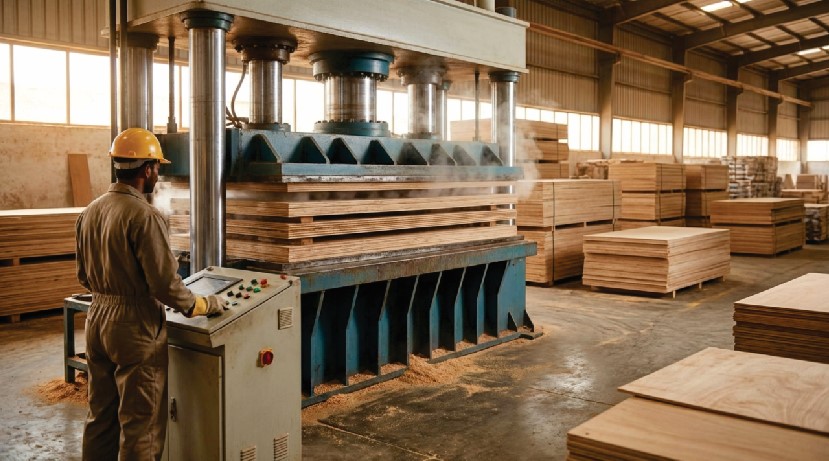
ii. Encourage Large Plywood & Panel Units
The Government may extend the benefits of the Production Linked Incentive (PLI) Scheme to encourage the establishment of large plywood and panel units, which will develop long term partnership with farmers for the promotion of production of industrial wood.
iii. Revise the EXIM Policy
The Government should support the goals of Aatmanirbharta in wood and wood products by promoting its local production and revising the EXIM Policy accordingly.
iv. Parity with Agricultural Crops
The Government should provide tree crops parity by extending the institutional support and facilities available to conventional agricultural crops. These should include easy and affordable credit, crop insurance, price-deficiency support schemes such as the Bhavantar Bharpai Yojana, access to e-NAM and other digital marketing platforms, and other appropriate risk-mitigation and market-support mechanisms.
v. Payment for Carbon Sequestration and Ecosystem Services
The Government should develop institutional mechanism for providing incentives to farmers for their contribution in providing Carbon Sequestration and Ecosystem Services.

- Conclusion
India’s plywood and panel industry is at a critical juncture, with the availability of affordable and sustainable industrial wood emerging as the major constraint to future growth.
Since the bulk of India’s industrial wood already comes from agroforestry, expanding and strengthening farmer-based tree cultivation must become a national priority. The successful experiences of WIMCO and ITC Bhadrachalam demonstrate that strong industry-farmer partnerships, can create reliable raw-material supplies.
The Government should provide tree crops parity with agricultural crops in providing incentives, while simplifying harvesting and transit regulations.
The plywood and panel industry, through FIPPI and individual companies, should move from a procurement-oriented approach to a proactive farmer-partnership model.
A coordinated national programme involving Government, industry and farmers is therefore essential to substantially increase domestic wood production, reduce dependence on imports, improve farm incomes and ensure long-term raw-material security.
Industrial wood security should be treated not merely as an industry requirement, but as a strategic national priority for achieving Atmanirbhar Bharat.

 Hindi

Ply insight launched on March 2018 with a vision to make a platform to collaborate plywood MDF, Laminate, machinery manufactures with dealers in the Trade.
Categories
Useful Links
Follow Us