

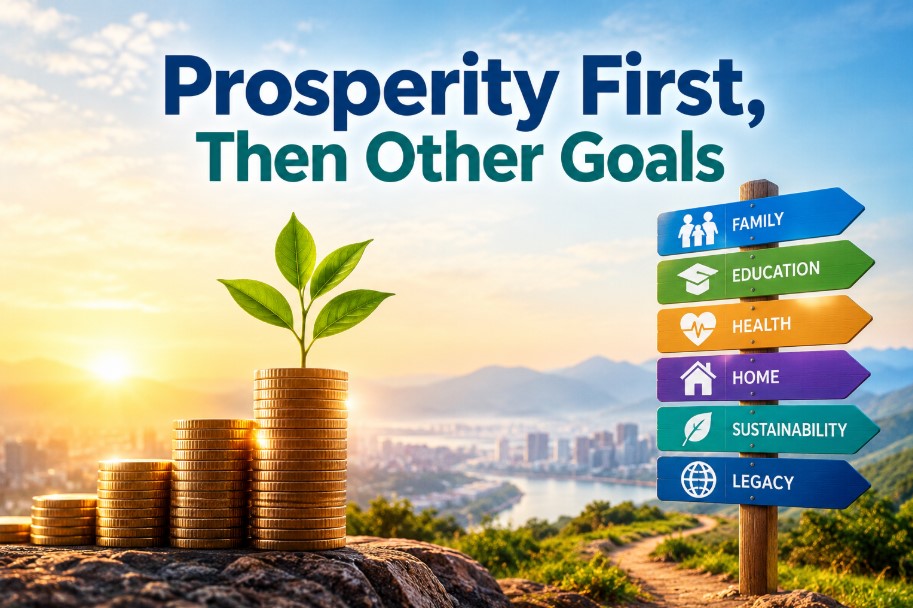
Prosperity First, Then Other Goals
- October 26, 2026
- 0
The Indian economy grew at the rate of 7.8% in the April–June quarter. However, this figure also serves as a warning. According to World Bank estimates, India will need to maintain an average growth rate of 7.8% for more than two decades to achieve its goal of becoming a Viksit Bharat.
Unfortunately, the 2047 target of Viksit Bharat could be affected by India’s climate commitment to achieve net-zero emissions by 2070. These two goals pull in opposite directions. One promises greater opportunities for Indians, while the other could lead to higher costs and slower economic growth.
NITI Aayog’s 11-volume report estimates that India will need to spend an additional $8.1 trillion in investment to achieve carbon neutrality by 2070. This amount is equivalent to forgoing two years of economic output at the current level of GDP, or spending 4% of today’s GDP every year for half a century.
The report acknowledges that achieving net zero will significantly increase energy costs, thereby affecting economic growth. Economic studies generally suggest that such indirect effects can be substantial. Meanwhile, environmental campaigners argue that climate change is one of the many challenges of the 21st century that must be addressed. However, it often receives disproportionate attention in the news.

Even if India bears the enormous cost of achieving net zero by 2070, the resulting climate benefits would be almost negligible. An analysis using the United Nations climate model MAGICC, comparing India’s projected emissions under current policies with those under a net-zero policy, suggests that the difference in global temperatures by the end of this century would be just 0.16°C—so small that it would be difficult to measure.
Moreover, India will need to focus exceptionally strongly on economic growth and benefit from favourable conditions to become a high-income country by 2047. Continuously spending resources equivalent to 4% of GDP could jeopardise this goal.
According to the United Nations climate panel’s medium-emissions scenario, the average Indian will be 791% more prosperous by the end of this century than today. Becoming a high-income country will bring numerous benefits. Therefore, India should focus on achieving the goal of Viksit Bharat (Developed India). This goal can be accomplished through a range of policies, each of which can deliver meaningful results in its own right. Excessively stringent climate policies may bring only a marginal reduction in risks far into the future, whereas better healthcare services can deliver immediate and substantial benefits at a much lower cost.
India should pursue the goal of Viksit Bharat with full determination and invest in highly effective policies that accelerate economic growth.
👇 Please Note 👇
Thank you for reading our article!
If you don’t received industries updates, News & our daily articles
please Whatsapp your Wapp No. or V Card on 8278298590, your number will be added in our broadcasting list.
Join our WhatsApp Channel “Ply & Panel Ind. News”




 Hindi

Ply insight launched on March 2018 with a vision to make a platform to collaborate plywood MDF, Laminate, machinery manufactures with dealers in the Trade.
Categories
Useful Links
Follow Us