

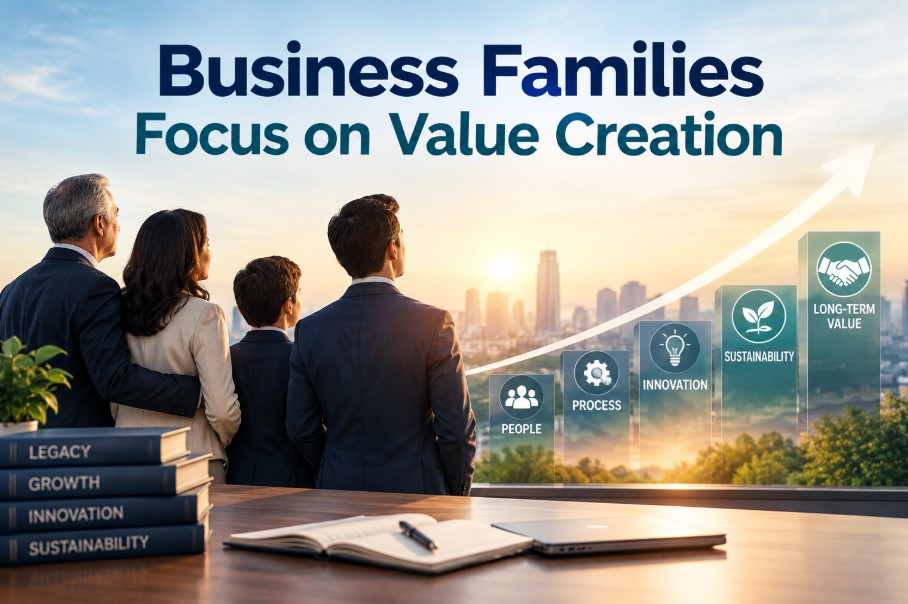
Business Families Focus on Value Creation
- October 24, 2026
- 0
India has demonstrated its ability to create wealth, but the bigger challenge now is to preserve it, give it a meaningful purpose and transfer it responsibly to the next generation. Wealth should not be viewed merely as personal ownership, but as a responsibility entrusted to the present generation to be passed on to the next.
Many large Indian business groups are facing challenges related to wealth distribution, succession, management and the future direction of their businesses. Amid emerging technologies such as artificial intelligence (AI) and changing geopolitical dynamics, preserving wealth alone will not be enough for business families. Their long-term success will depend on how effectively they prepare the next generation and build institutions capable of continuing to create value even after the founders are gone.
Indian business families are increasingly emphasising the need to develop the next generation as responsible stewards of wealth and transform businesses into institutions capable of sustaining growth well into the future.
The responsibility of the next generation extends beyond inheriting wealth. They are also expected to preserve family values, business traditions and long-term objectives. At the same time, they must have the freedom to shape the future of the business and take the institution forward.

Initially, founders retain control of the business while seeking support from external experts. Over time, successors become more comfortable with professional management. Eventually, a hybrid model emerges in which family guidance and professional expertise work together. The objective is not to replace family decision-making, but to establish clarity, accountability and institutional strength so that the family’s role and professional management can function effectively.
Joint participation by family members and professional management has emerged as the most common model for major business decisions. Alongside this, the use of committees, professional advisers and formal governance structures is also increasing.
Priorities differ across generations. Founders tend to prefer family-led management supported by advisers. Members of the second generation are more inclined towards professional management under family oversight. The third generation, meanwhile, is moving towards a hybrid model that combines family involvement with professional expertise.
👇 Please Note 👇
Thank you for reading our article!
If you don’t received industries updates, News & our daily articles
please Whatsapp your Wapp No. or V Card on 8278298590, your number will be added in our broadcasting list.
Join our WhatsApp Channel “Ply & Panel Ind. News”



 Hindi

Ply insight launched on March 2018 with a vision to make a platform to collaborate plywood MDF, Laminate, machinery manufactures with dealers in the Trade.
Categories
Useful Links
Follow Us