


Elixrr’s Entry into the Growing Market of MDF
- July 13, 2026
- 0
Please introduce Elixrr Industries and its core business operations.
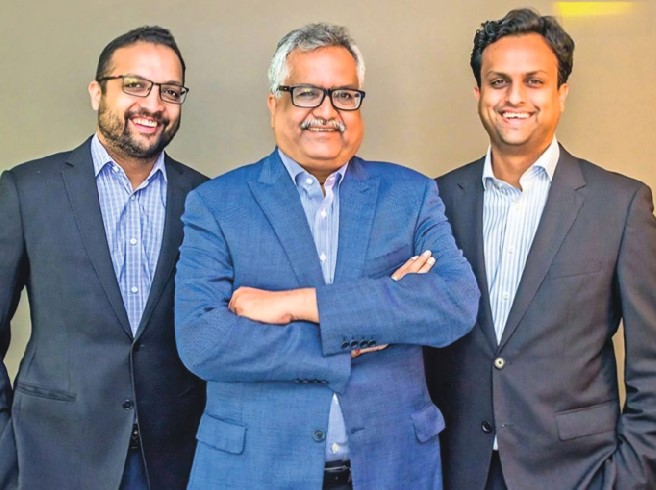
Under the leadership of Arun Goyal, Madhav Goyal, and Saurabh Goyal, Elixrr Industries Pvt. Ltd. is an emerging manufacturing company primarily engaged in the production of non-woven fabrics.
Operating a state-of-the-art facility in Gujarat with an annual production capacity of 15,000 MT, Elixrr manufactures spunlace non-woven materials that are widely used in wipes, diapers, medical products, and various industrial applications.
What are Elixrr’s plans in the wood panel industry?
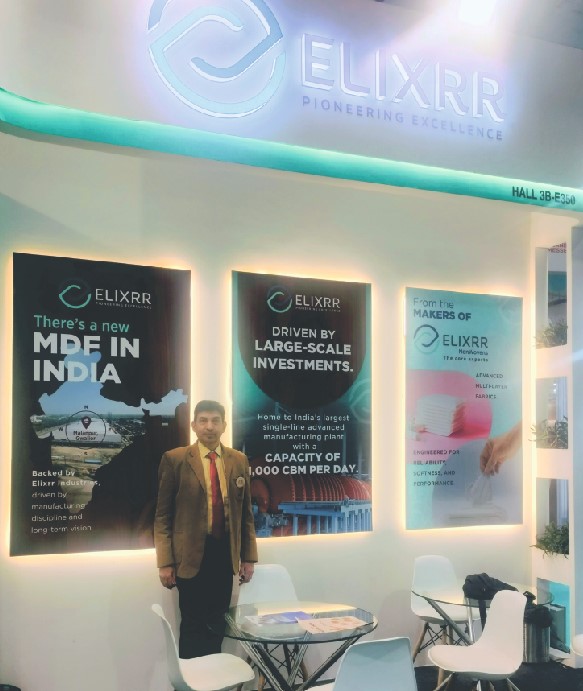
Diversifying its core business, Elixrr is setting up one of India’s largest single-line MDF plants in Gwalior (Central India) with an initial production capacity of 300,000 CBM per annum. The facility will feature a continuous press line with a width of 8 feet and a production capacity of 1,000 CBM per day.
What technology will be used in the new MDF plant?
The plant will be equipped with advanced AI-driven autonomous process control technology imported from Siempelkamp, Germany, whose machinery and technology are regarded among the best in the world. The facility will have the capability to manufacture products with densities ranging from 750 to over 1000 kg/m³.
Could you tell us about your value-added panel manufacturing facilities?
Utilizing advanced adhesive technology, the unit will commence operations with one 10×4 pre-lamination press, one 8×6 pre-lamination press, and three 8×4 pre-lam presses, imported from WEMHÖNER of Europe, a company renowned for its commitment to precision and cutting-edge technology.
How has the recent geopolitical situation affected the industry?
Following the outbreak of the Gulf War, prices of key energy sources such as crude oil and natural gas, along with chemicals, rose sharply, leaving the industry shocked and under immense pressure. The steep increase in production costs forced manufacturers to raise prices in order to protect their businesses, and the market gradually accepted these increases. Although fluctuations in raw material prices continue, supplies remain available. Consequently, while the industry remains concerned about the future, day-to-day operations are continuing without major disruptions.

What is your outlook for the industry in the coming years?
Given the uncertainty surrounding the conflict and its inflationary impact, the industry cannot afford to be complacent this year. However, if businesses remain focused on long-term planning, the coming years could prove highly beneficial for both India and the industry. Those investing today with a long-term perspective are likely to be in the strongest position tomorrow.
How do you see the MDF market evolving in India?
Over the next few months, several new MDF plants, including ours, are expected to commence operations. Newly established companies have also expanded their manufacturing capacities. According to industry estimates, India’s MDF production capacity is growing at an annual rate of 15–20 percent. This reflects the steadily increasing popularity of MDF among architects, interior designers, and carpenters. While MDF continues to expand its presence in a market traditionally dominated by plywood, this growth is occurring gradually but consistently.
HDHMR different from MDF?
An important trend is the rising acceptance and popularity of HDHMR (High Density High Moisture Resistant Board), which is gaining traction even faster than MDF in certain applications. Its density range of 720 to 850+ kg per cubic meter provides inherent strength, resulting in superior screw-holding capability and enhanced resistance to bending and cracking. Additionally, its excellent moisture resistance and significantly lower swelling rate compared to MDF and particle board have further contributed to its growing demand.
With growing MDF capacity, how sustainable supply of wood can be ensured?
As India’s MDF manufacturing capacity continues to increase, raw material costs are also expected to rise. Therefore, it becomes the collective responsibility of both existing and new manufacturers to promote agroforestry in order to ensure a sustainable supply of wood. Since the availability of private land in India is limited, encouraging farmers to adopt agroforestry remains the industry’s most viable solution.
This year, we have set a target of distributing more than two million saplings among farmers. Government-sponsored farmer fairs and agricultural outreach programs provide an excellent platform for engaging with farmers and encouraging plantation activities.
What are the major challenges facing exports of wood panel products from India?
Until logistics in India become more cost-effective, exports of plywood and panel products are unlikely to become highly profitable. Certain manufacturers receiving tax incentives may be exceptions. In addition, the size of shipping containers presents a challenge for the commonly manufactured 8×4 ft panel size, resulting in a loss of approximately 20–25 percent of available container space.
However, markets for value-added products such as furniture, carved products, and engineered decorative products are gradually expanding.
How do you view MDF imports into India?
The size of shipping containers is also one reason why MDF imports remain limited and are generally restricted to thicknesses that Indian manufacturers are less inclined to produce.
What impact has the Quality Control Order (QCO) had on the industry?
The implementation of the Quality Control Order (QCO) has undoubtedly provided significant relief to Indian manufacturers from imported products. There is a fundamental difference between BIS quality standards for plywood and MDF. To support domestic plywood manufacturers, several quality categories have been introduced, making compliance monitoring more difficult and creating opportunities for misuse by foreign manufacturers, importers, traders, or distributors.
In contrast, MDF standards prescribe a clearly defined minimum quality benchmark that many imported products fail to meet. Consequently, Indian MDF manufacturers have benefited considerably from the implementation of QCO regulations.
👇 Please Note 👇
Thank you for reading our article!
If you don’t received industries updates, News & our daily articles
please Whatsapp your Wapp No. or V Card on 8278298590, your number will be added in our broadcasting list.
Please follow our Whatsapp Channel “Ply & Panel Ind. News”



 Hindi
Hindi 
Ply insight launched on March 2018 with a vision to make a platform to collaborate plywood MDF, Laminate, machinery manufactures with dealers in the Trade.
Categories
Useful Links
Follow Us