

Despite being the largest producer of teak, India is the largest importer
- अक्टूबर 14, 2026
- 0
Present Status
India is blessed with one of the richest teak (Tectona grandis) resources in the world. Nearly 44% of the world’s natural teak forests occur in India, spread across Madhya Pradesh, Maharashtra, Chhattisgarh, Odisha, Gujarat, Telangana, Andhra Pradesh, Karnataka, Kerala and Tamil Nadu (ITTO, 2022; FSI, 2023). Scientific teak plantation forestry started in 1842 at Nilambur (Kerala), making India the pioneer of managed teak plantations (Troup, 1921).
During the last 180 years, State Forest Departments (SFDs) have established lakhs of hectares (ha) of teak plantations, while farmers have increasingly raised teak plantations under agroforestry systems. According to the India State of Forest Report (ISFR) 2023, teak is the second most important tree species in Recorded Forest Areas (RFAs) with a growing stock of 1996 lakh m³ (FSI, 2023).
Under agroforestry, teak has shown one of the fastest rates of expansion, with the number of trees increasing from 752 lakh in 2013 (10th rank) to 2543 lakh in 2023 (6th rank), while its growing stock more than doubled from 113 lakh m³ to 233 lakh m³ during the same period (FSI, 2023). These figures clearly indicate that India possesses a strong biological resource base for becoming self-reliant in teak timber.
Import of Teak Timber
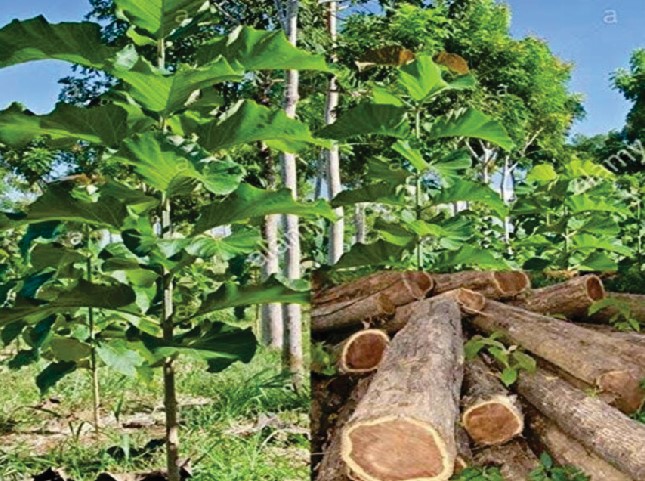
Ironically, despite this enormous resource base, India imports 10 lakh m³ of teak logs and sawn timber annually, making it the world’s largest teak importer (DGCI&S, 2023–24; ITTO, 2023). Imported teak is primarily used for furniture, doors and window frames, flooring, interior paneling, staircases and decorative joinery, housing projects, plywood and veneer industries.
Most imports originate from Myanmar, Ghana, Togo, Nigeria, Tanzania, Ecuador, Costa Rica and Panama (ITTO,2023). Their success lies not in superior quality timber but in lower production costs. Teak plantationsin Africa and Latin America are generally harvested on 20–30 year rotationusing genetically improved planting stock, intensive silviculture, mechanized harvesting and integrated supply chains.
Consequently, imported plantation teak often reaches Indian markets at ₹1,500–2,500/cft, whereas teak sold through SFD depots commonly ranges from ₹2,500–6,000/cft, with premium grades commanding much higher prices.
Thus, the challenge is not the quality of Indian teak but its cost competitiveness and market orientation. The annual import bill for teak is estimated at US$350–700 million (₹3,000–6,000 crore). This represents a significant outflow of foreign exchange for a commodity that India has the ecological capacity to produce domestically.
Strategy to Reduce Import of Teak Timber
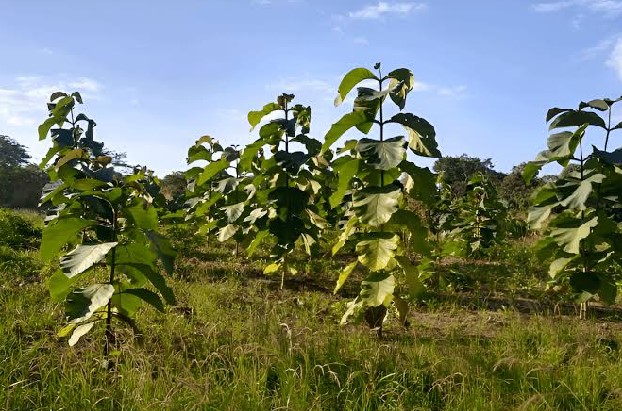
The following strategy may be adopted to enhance the productivity of teak plantations in India.
A. Forest Lands
Teak plantations on forest lands may be managed under following production categories.
Premium Teak Production by State Forest Departments
A differentiated management strategy should be adopted for the SFDs, with the primary objective of producing premium-quality teak for high-value domestic and export markets. The traditional rotation period of 80–100 years may be rationalized to about 60–70 years through scientific silvicultural interventions, while still producing large-diameter, high-quality timber.
Within forests, SFDs should concentrate on the production of premium-grade teak suitable for luxury furniture, decorative veneers, and other high-value applications.
Industrial Teak Production by Forest Development Corporations
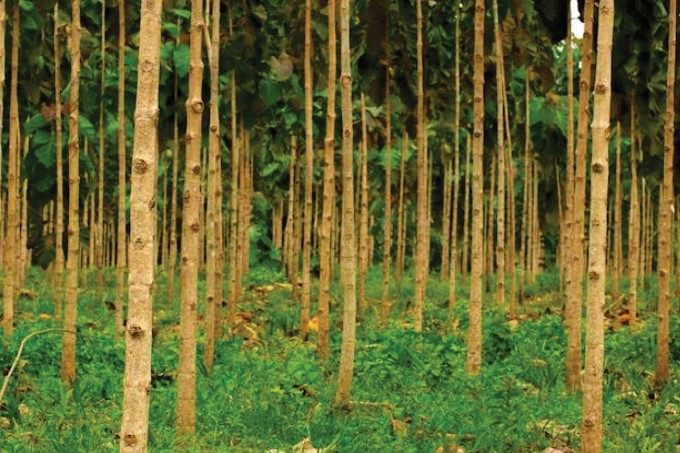
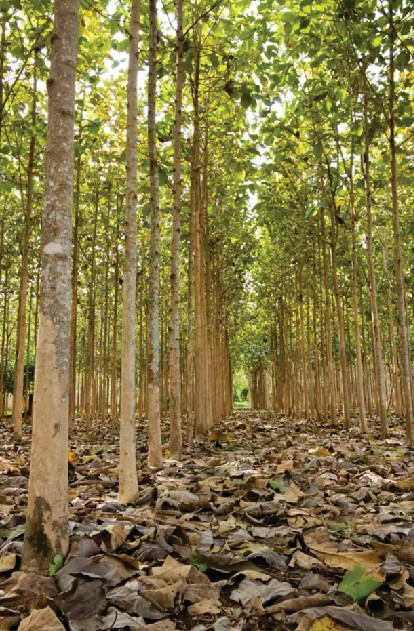
Forest Development Corporations (FDCs), being the commercial organisations, should focus on the production of industrial-grade teak to substitute imported teak. A rotation period of 25-35 years may be adopted to produce medium-diameter timber suitable for the domestic furniture, joinery, plywood, and construction industries. This strategy would enable faster harvesting cycles, improve financial returns, and reduce India’s dependence on imported teak.
The traditional approach of planting teak must be replaced by a scientific production model based on site-species matching, quality planting stock, timely silvicultural interventions, and productivity enhancement.
Simultaneously, timber marketing systems require modernization through e-auctions, timber exchanges, certification, and long-term supply agreements with wood-based industries (WBIs).
With the adoption of improved genetics and scientific management practices, the productivity of teak plantations can potentially increase from the present 4–8 m³/ha/yr to 12–15 m³/ha/yr. Such productivity levels have already been demonstrated under intensive plantation management in tropical countries (ITTO, 2022; FAO, 2020).
B. Trees Outside Forests
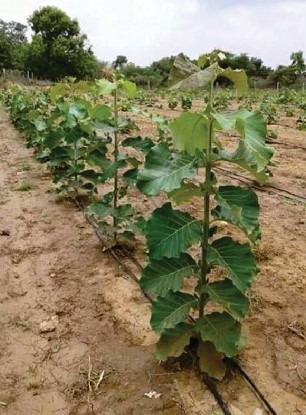
The greatest opportunity for reducing teak imports lies in expanding teak plantations under Trees Outside Forests (TOF). Recent assessments indicate that TOF already contribute the major share of industrial wood production in India (ICFRE, 2025; EAC-PM, 2024).
National Teak Development Mission
The major opportunity for import substitution lies outside forests. The Economic Advisory Council to the Prime Minister has similarly emphasized that agroforestry represents India’s largest untapped opportunity for increasing domestic wood production (EAC-PM, 2024). Farmers can produce medium-rotation teak in 20 to 30 years much more economically than FDCs because of lower establishment costs, better supervision and integration with agricultural operations.
However, farmers will adopt medium rotation teak only if it becomes financially competitive with other species like poplar, eucalyptus, casuarina and Malabar neem. The Government should, therefore, introduce a comprehensive package of incentives, including: (i) 75% subsidy on certified clonal planting material; (ii) establishment assistance of 50% during first three years; (iii) long-term plantation credit with interest subvention; (iv) subsidized tree insurance against fire and pests (v) annual payments for ecosystem services and carbon sequestration; and(vi) simplified transit regulations as done by Maharashtra. ITTO, 2022).Research institutions should complement these policy measures by developing high-yielding teak clones. Research priorities should include increasing heartwood formation at younger ages, improving bole straightness, optimizing spacing and thinning regimes, and enhancing wood density. The objective should be to produce uniform plantation teak comparable in quality, dimensions and price to imported teak.
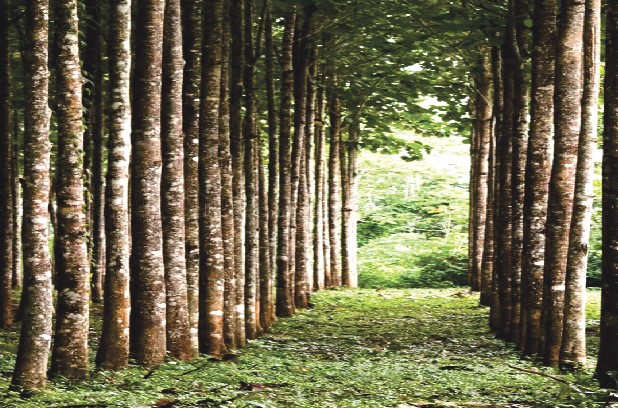
The Ministry of Environment, Forest and Climate Change should, therefore,consider launching a National Teak Development Mission with a clearly defined objective of making India substantially self-reliant in teak timber by 2047, coinciding with the centenary of Independence. recommendations of the Economic Advisory Council to the Prime Minister (2024).
The Mission should integrate production forestry, agroforestry, research, financial incentives, market reforms and industrial partnerships under a single national programme. The mission may initiate an All India Coordinated Research Project on Teak under ICFRE. Success should be measured not merely in hectares planted but in reduction of imports and foreign exchange saved.
India possesses one of the world’s largest natural teak resources, a strong scientific base and lakhs of enterprising farmers. The challenge today is no longer one of growing more teak, but of producing the right quality of teak at the right price.
A market-oriented Mission can transform India’s annual import of10 lakh m³ of teak from a recurring economic burden into strategiceconomic opportunity-generating rural employment and prosperity, stimulating WBIs,achieving self-reliance in quality timber, and ultimately positioning India as a globally competitive exporter of teak.
निष्कर्ष
India led the world in scientific teak plantation forestry in 1842 (Troup, 1921). Nearly two centuries later, it is paradoxical that the country remains the world’s largest importer of teak timber (DGCI&S, 2023–24; ITTO, 2023).
A National Teak Development Mission should therefore become an integral component of Viksit Bharat@2047, aiming to transform India from the largest importer of teak into a globally competitive producer and exporter of sustainable, high-quality plantation teak.
Such a mission would not merely reduce imports; it would simultaneously enhance farmers’ incomes, strengthen revenue of SFDs, create rural employment, conserve foreign exchange, unlock export potential and contribute to a more self-reliant Indian economy.
- Directorate General of Commercial Intelligence and Statistics (DGCI&S). 2024. Foreign Trade Statistics of India, 2023–24. Ministry of Commerce and Industry, Government of India, Kolkata.
- Economic Advisory Council to the Prime Minister (EAC-PM). 2024. Agroforestry: Missing Trees for the Forest. Government of India, New Delhi.
- Food and Agriculture Organization (FAO). 2020. Global Forest Resources Assessment 2020: Main Report. FAO Forestry Paper No. 188. Food and Agriculture Organization of the United Nations, Rome, Italy.
- Forest Survey of India (FSI). 2023. India State of Forest Report 2023. Ministry of Environment, Forest and Climate Change, Government of India, Dehradun.
- Indian Council of Forestry Research and Education (ICFRE). 2025. Production and Consumption of Timber in India–2025. ICFRE, Dehradun.
International Tropical Timber Organization (ITTO). 2022. Status of Tropical Forest Management 2022.
- International Tropical Timber Organization, Yokohama, Japan.
- International Tropical Timber Organization (ITTO). 2023. Annual Review and Assessment of the World Timber Situation 2023. ITTO, Yokohama, Japan.
- National Agroforestry Policy. 2014. Department of Agriculture & Cooperation, Ministry of Agriculture, Government of India, New Delhi.
- Troup, R.S. 1921. The Silviculture of Indian Trees. Volume II. Oxford University Press, London.

 English
Ply insight launched on March 2018 with a vision to make a platform to collaborate plywood MDF, Laminate, machinery manufactures with dealers in the Trade.
Categories
Useful Links
Follow Us