

India’s Resilience against the West Asia storm
- June 13, 2026
- 0
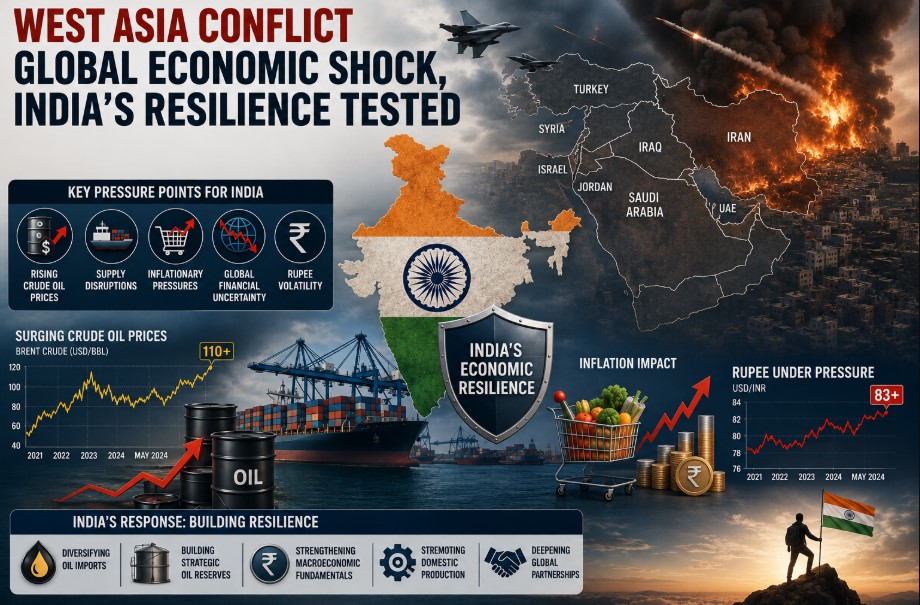
The ongoing conflict in West Asia is creating major economic challenges globally and testing India’s economic resilience through multiple pressure points such as rising crude oil prices, supply disruptions, inflation, and global financial uncertainty.
The conflict has triggered one of the largest oil and gas shocks in recent decades. Since India imports a large share of its crude oil and natural gas from the Gulf region, the country is highly vulnerable to rising energy costs and supply chain disruptions.
Key Economic Risks
- Pressure on External Account
Higher crude oil prices are expected to significantly increase India’s import bill, widen the current account deficit, and weaken the rupee. The Gulf region also contributes heavily to India’s remittance inflows, making any slowdown there an additional concern.
- Rising Input Costs for Industries
Industries dependent on imported fuel, chemicals, fertilizers, and petrochemical products are facing rising production costs. Sectors such as pharmaceuticals, textiles, packaging, and specialty chemicals along with plywood and panel industry are already seeing pressure due to shortages and cost escalation.
- Fiscal Pressure on Government
The government is facing increased subsidy burdens, especially in fertilizers and fuel-related sectors. Reduced fuel taxes and support measures is impacting fiscal management despite India’s relatively stable fiscal position.
- Export Demand Challenges
Global uncertainty and slower economic activity may affect export demand. However, India’s diversified export basket and services sector continue to provide some stability.

- Financial Market Volatility
Tighter global financial conditions and a stronger US dollar are increasing borrowing costs and putting pressure on the rupee. Still, India’s strong foreign exchange reserves and RBI’s liquidity management are acting as important safeguards.
Positive Factors Supporting India
Despite these challenges, India remains relatively resilient compared to many economies. The IMF has upgraded India’s growth forecast to 6.5%, making it one of the few major economies with an improved outlook.
The government has also taken several strategic measures, including:
- Diversifying crude oil sourcing,
- Maintaining strategic reserves,
- Managing fuel supplies carefully,
- Expanding renewable energy capacity,
- And strengthening energy security policies.
Long-Term Lessons
The crisis highlights the urgent need for India to:
- Reduce dependence on imported energy,
- Expand renewable energy,
- Strengthen domestic manufacturing and supply chains,
- Build strategic reserves,
- And accelerate the energy transition toward solar, wind, ethanol, and green hydrogen.
India’s resilience is not accidental but the result of policy planning, diversification, and coordinated action between government and industry.
👇 Please Note 👇
Thank you for reading our article!
If you don’t received industries updates, News & our daily articles
please Whatsapp your Wapp No. or V Card on 8278298590, your number will be added in our broadcasting list.
Join our Whatsapp Channel “Ply & Panel Ind. News”


 Hindi
Hindi 
Ply insight launched on March 2018 with a vision to make a platform to collaborate plywood MDF, Laminate, machinery manufactures with dealers in the Trade.
Categories
Useful Links
Follow Us